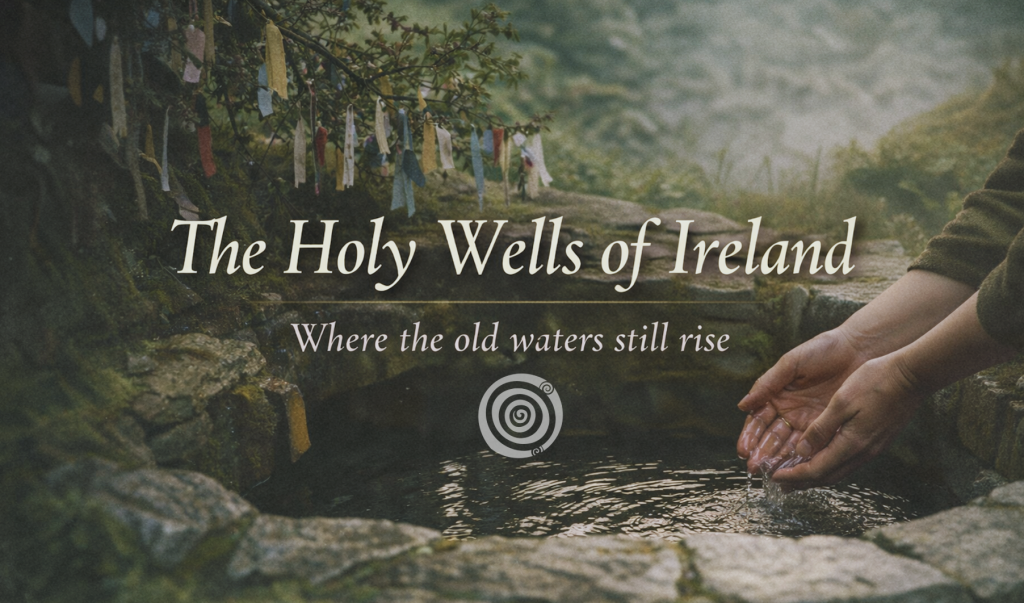
There is a particular stillness at an Irish holy well that does not feel empty. It feels inhabited. The sound of water rising through stone, the touch of moss on an old wall, a ribbon moving lightly on a thorn tree – these places ask for a different kind of attention. The holy wells of Ireland are not merely old sites marked on a map. They are living thresholds where prayer, memory and the presence of the land continue to meet.
For those who feel drawn to Ireland in a way that is difficult to explain, holy wells often become one of the deepest points of recognition. Not because they are grand, but because they are intimate. A mountain can overwhelm. A well invites. You come close, you kneel, you listen. What happens there is rarely dramatic in the outward sense. Yet many people leave with the unmistakable sense that something in them has quietened, softened, or been remembered.
Why the holy wells of Ireland still matter
Ireland holds thousands of holy wells, and no two carry exactly the same atmosphere. Some are dedicated to saints such as Brigid, Declan, Gobnait or Columba. Some seem older still, their Christian names layered over pre-Christian reverence for springs and waters that were already held as sacred. That layering matters. It tells us something essential about Ireland’s spiritual life – not that one tradition simply replaced another, but that the sacred often continued through adaptation, devotion and relationship with place.
This is why a holy well should never be reduced to a quaint stop or a curious remnant of folk religion. In Ireland, wells have long been places of healing, petition, blessing and pattern day pilgrimage. People came for sore eyes, troubled hearts, difficult births, broken sleep, grief, and guidance. They came because water was not seen as separate from spirit. The well offered medicine, but also mediation – a place where human need could be spoken in the presence of something older and wiser than the self.
That living thread has not disappeared. It has simply become quieter in a culture that often struggles to make room for reverence. Yet when you stand at a well where generations have prayed before you, the continuity is palpable. The place has been fed by devotion. That matters.
What happens at a holy well
There is no single correct way to approach a well, and that is part of their integrity. Some people arrive in silence. Some offer prayers for the dead or for the living. Some drink the water where it is safe to do so. Some make rounds, circling the well or the surrounding stones in a devotional pattern that echoes older pilgrimage practice. Others leave a small offering – not as clutter, but as a sign of presence and gratitude.
The trade-off, if we can call it that, is that a holy well does not always give the modern mind what it wants. It may not offer explanation, immediate comfort, or a neat spiritual experience. Some wells feel welcoming at once. Others feel guarded. Some are beautifully tended. Others lie half-hidden at the edge of a field, asking for humility rather than certainty. It depends on the well, the season, and the state in which you arrive.
That is one reason guided pilgrimage matters. Sacred sites are not interchangeable, and the deeper meaning of a place is not always visible from the surface. To visit a well with context – mythic, historical, ceremonial and energetic – is to meet it more truthfully. This is not about being told what to feel. It is about being brought into right relationship.
This is not about seeing more.
It is about seeing differently.
Holy wells of Ireland as places of healing
Healing at a holy well has never been only physical, though many wells are associated with specific ailments. In Irish tradition, healing is often woven through body, spirit, ancestry and land. A person may come seeking relief from one thing and find that what rises instead is grief, memory, forgiveness or a sense of return. The well becomes a mirror as much as a remedy.
This is where many modern visitors misunderstand the nature of sacred water. They look for proof in the narrowest sense, as if the value of the place must be measured only by what can be clinically verified. But pilgrimage works on more than one level. A holy well can restore by slowing the body, focusing intention, and opening a space where the deeper self can speak. That does not make the experience vague or fanciful. It makes it human.
In the Celtic spiritual imagination, water carries memory. It moves between worlds. It cleanses, blesses and reveals. At certain wells dedicated to Brigid, for example, people still experience a profound tenderness – a maternal, creative, steadying presence that seems to belong both to the saint and to something more ancient moving through her. At other wells, the atmosphere is sterner, more ancestral, more demanding. Again, it depends.
The etiquette of entering a sacred well site
To approach a holy well, you must slow down enough to notice what kind of place you are entering. Not every site wants chatter, photography or hurried interpretation. Some are held in active local devotion. Some are fragile. Some have already suffered from careless visitors leaving objects that do not belong there.
A respectful approach is simple. Arrive quietly. Observe before acting. If prayers or rounds are part of the local tradition, follow them with care rather than performance. Leave no trace that burdens the site. And resist the urge to take from the place more than you are willing to offer in return.
This is one of the clearest distinctions between pilgrimage and ordinary travel. A pilgrim does not consume a sacred site. A pilgrim enters into relationship with it. That relationship includes reverence, reciprocity and a willingness to be changed.
Why wells are different when experienced in pilgrimage
Many people can find a holy well. Far fewer know how to meet one.
There is a difference between arriving at a site and being prepared for it. On a true spiritual journey, the well is not isolated from the wider sacred landscape. It belongs to a web of mountains, monastic ruins, cairns, feast days, old stories, local keepers and seasonal energies. A well visited near Bealtaine carries one current. Near Samhain, another. A dedication to Brigid opens one doorway. A well tied to a local saint with healing rites opens another.
This is why the most meaningful encounters often happen within a carefully held pilgrimage rather than a self-directed itinerary. The land speaks in relationship. Ceremony deepens listening. Story restores context. Group energy, when held well, can make room for personal experience without forcing it. What emerges is not a checklist of sacred places, but an inner movement – sometimes subtle, sometimes life-changing.
This is exactly why we guide small, pilgrimage-led journeys across Ireland.
Not to show you more places, but to help you meet them properly.
Through story, ritual, silence and presence, the wells are not approached as stops on a route, but as living places within a wider sacred landscape.
This is not a tour.
It is a different way of travelling entirely.
→ Explore our sacred journeys through Ireland
What the holy wells of Ireland ask of us now
In a restless age, holy wells offer a counterpoint. They do not rush. They ask for patience instead. They ask for patience, sincerity and attention. For some, that will feel unfamiliar at first. For others, it feels like relief.
Perhaps that is why these places continue to call people across oceans and across years. Not because they promise spectacle, but because they hold depth. They remind us that the sacred can be small, local, elemental. That transformation does not always arrive through intensity. Sometimes it comes through kneeling beside cold water and feeling, perhaps for the first time in a long time, that you are not separate from the living world.
For those drawn to the holy wells of Ireland, trust that call enough to meet it properly. Let it become more than curiosity. Let it become pilgrimage. The old waters are still rising.
The question is whether you are willing to come close enough to listen, and to follow where that leads.