There are places in Ireland where people still lower their voices without being asked. A circle of stones beside a spring. A hawthorn tree tied with ribbons. A quiet pool carrying prayers older than memory. A healing wells Ireland tour is not simply a route between holy sites. It is a return to the waters where generations came with grief, illness, longing and faith, asking the land itself to help restore what had been lost.
For the spiritually called traveller, these wells speak in a language deeper than heritage boards and coach stops. They belong to a living tradition. Some are linked with saints, some with older goddesses and local spirits of place, and many hold both stories at once. Ireland has always carried its layers openly. Christian devotion and pre-Christian reverence often sit side by side here, not as contradiction, but as continuity.
Why a healing wells Ireland tour feels different
Most tours move quickly. They collect landmarks, dates and photographs. Sacred travel asks something else of you. It asks you to arrive slowly enough to feel where you are.
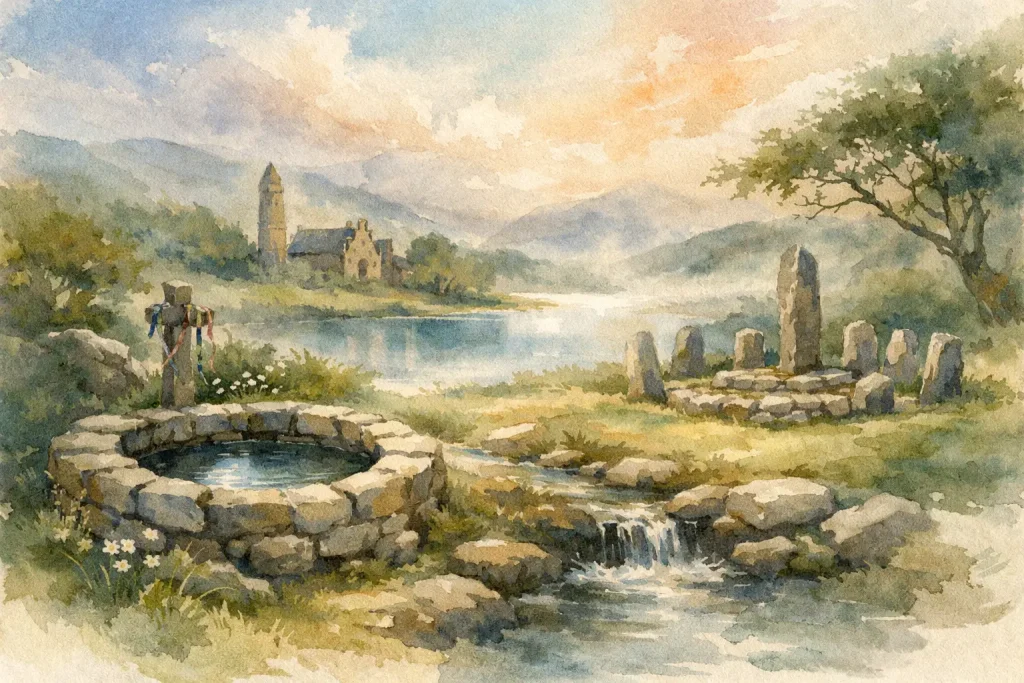
Healing wells are powerful precisely because they are modest. You will not always find grandeur. Often you will find a stone basin in a field, a spring near a ruined church, or a shaded place on the edge of a small rural road. Yet these are the sites people returned to in times of fever, heartbreak, infertility, anxiety and spiritual unrest. The tradition was simple but profound – pray, circle the well, leave an offering, drink or wash in the water if that was the local custom, and listen for what changed inside you.
That is why this kind of journey matters. It shifts the focus from seeing Ireland to meeting Ireland. Not as scenery. Not as brand. As living presence.
The sacred history held in Ireland’s wells
A healing wells Ireland tour opens a doorway into one of the most enduring spiritual lineages on the island. Holy wells are found across every county, and many have been tended for centuries. Some are connected to pilgrimage days and pattern days, when communities gathered for prayer, blessing and seasonal rites. Others remain quieter, known mostly by locals who still leave coins, cloth, flowers or whispered intentions.
Water has always been a threshold element in Celtic lands. It cleanses, blesses, remembers and reveals. Wells, springs and rivers were long understood as points of contact between worlds. When Christianity spread through Ireland, many of these sacred water places were adopted into the cult of saints, especially St Brigid, whose presence at wells across the island still carries unusual warmth and intimacy.
That layering matters. If you approach these sites only through one religious frame, you may miss their deeper texture. If you romanticise them as purely pagan, you flatten their lived history. The truth is richer. Ireland’s holy wells hold centuries of devotion from ordinary people who came in need. That human continuity is part of the medicine.
What happens at a holy well
It depends on the place. Customs vary from region to region, and respectful guidance matters. At one well, you may walk sunwise around the site while reciting prayers. At another, there may be a clootie tree nearby, where strips of cloth are tied as physical symbols of healing petitions. Some wells are for eye ailments, some for fertility, some for protection, some for emotional healing or relief from fear.
What makes the experience powerful is not performance. It is attention. The best encounters happen when there is time for stillness, story and proper context rather than hurried spiritual sampling.
What to look for in a healing wells Ireland tour
If this journey is calling you, discernment matters. Not every itinerary that uses spiritual language is rooted in the land. Some borrow the imagery of pilgrimage while delivering standard tourism with a mystical gloss.
A meaningful healing wells Ireland tour should be guided by people who understand place as relationship, not product. That means local knowledge, reverence for living traditions, and the wisdom to know when a site asks for ritual, silence or restraint. It also means accepting that not every well is meant for spectacle. Some should be visited quietly. Some should not be photographed at all. Some may ask more of your inner readiness than your travel schedule.
Look for a journey that allows spaciousness. Sacred water sites cannot be rushed without losing what they offer. The more commercial the pace, the thinner the encounter tends to become. Small groups are usually better. They allow for ceremony, reflection and a more intimate field of attention.
It also helps when the wider pilgrimage is woven around the wells rather than treating them as isolated curiosities. A holy well makes more sense when experienced alongside ancient churches, cairns, ring forts, seasonal festivals and stories of the saints, poets and wise women who kept these places alive.
More than healing – remembrance
Many people are drawn to Ireland’s wells when life has become too loud. Burnout, loss, transition, grief, hormonal change, creative exhaustion, spiritual numbness – these are modern words for ancient human thresholds. The wells do not offer a tidy promise. They are not wellness branding in old stone clothing. Their gift is subtler and often more lasting.
At a true sacred well, people often speak of remembrance. Not memory in the ordinary sense, but a felt recognition. A softening in the body. Tears without a clear story. A sense that something forgotten has been gently called back. For those with Irish ancestry, this can be especially potent, though ancestry is not a requirement for belonging. The land responds to sincerity, not bloodline alone.
This is why pilgrimage to the wells can be so transformative. It is not only about healing what hurts. It is about rejoining what has been split apart – body from spirit, prayer from place, traveller from earth, present self from ancestral thread.
The role of ritual and guidance
The difference between a moving visit and a life-marking one often lies in how the journey is held. Ritual gives shape to intention. Story opens the symbolic depth of the site. Silence allows what is hidden to rise.
A good guide does not impose meaning. They help you approach the well in a way that is respectful, grounded and spiritually safe. They know the folklore, the saint traditions, the old customs and the modern realities of the places being visited. They also understand that sacred sites are not there to perform on demand. Sometimes the deepest part of a day is what cannot be planned.
This is where a land-rooted pilgrimage company such as Ancient Spiritual Tours Ireland can offer something very different from standard touring. The value is not just access. It is being guided into right relationship with the place.
The inner posture to bring on this journey
Come with reverence, but not rigidity. You do not need to arrive with a perfected spiritual practice or a dramatic personal story. You only need honesty.
Bring an offering if it is appropriate and biodegradable. Bring a journal. Bring shoes that can handle muddy paths and weather that changes its mind. More importantly, bring your willingness to move at the pace of prayer rather than the pace of consumption.
Leave some space around your expectations. Not every well will move you in the same way. One may feel quiet. Another may stir something immediate and undeniable. The point is not to collect peak experiences. It is to enter a conversation with the sacred landscape and let it unfold in its own timing.
If you are travelling in a season such as Bealtaine or Samhain, the atmosphere may feel even more charged. Ireland’s ritual calendar still breathes through the land, and the wells are part of that breathing. In these threshold times, prayer can feel close to the surface.
Is this the right kind of pilgrimage for you?
If you want polished entertainment, probably not. If you want a spiritually themed holiday with little discomfort, it depends. Sacred travel in Ireland can be tender, beautiful and deeply nourishing, but it can also be weathered, raw and unexpectedly emotional.
If, however, you feel called by older rhythms, by sacred water, by the possibility that healing might come through relationship rather than escape, then this path may meet you exactly where you are. The wells ask for humility. They also offer companionship. So many have come before you carrying questions they could not solve alone.
Some left with cures. Some left with courage. Some simply left feeling less abandoned by life. That, too, is holy.
If Ireland’s healing wells are calling your name, trust the quietness of that call. Not every journey begins with certainty. Some begin with thirst.