The Celtic Wheel of the Year: How Ireland Marked Time Through Land, Light and Life
For thousands of years in Ireland, time was not measured by months or numbers on a calendar.
It was measured by what the land was doing.
By light and darkness. By growth and decay. By birth, ripening, harvest and rest. This way of understanding time is known today as the Celtic Wheel of the Year.
It is not symbolic. It is practical, seasonal, and deeply embodied.
And it still shapes how Ireland feels, even now.
What Is the Celtic Wheel of the Year?
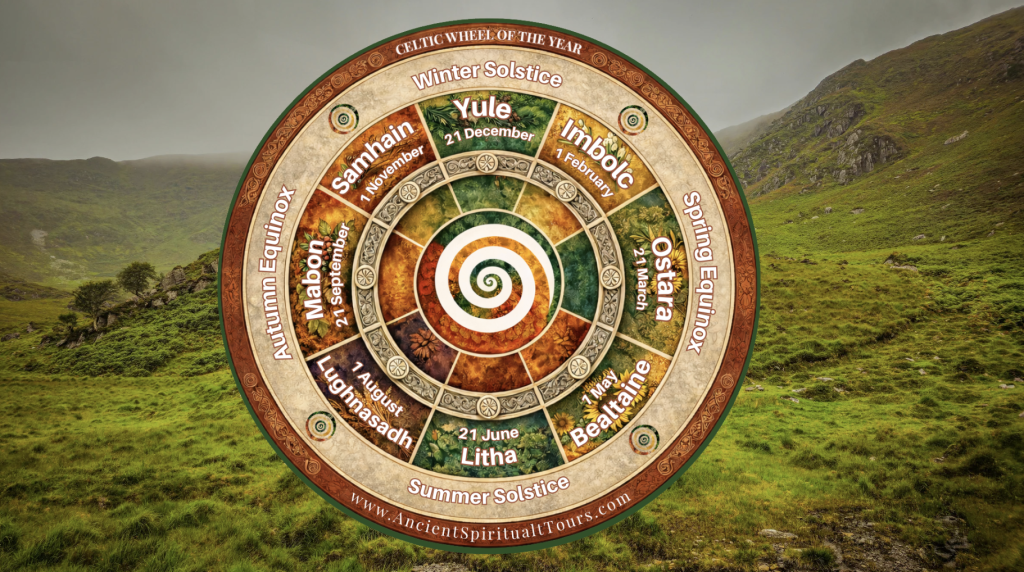
The Celtic Wheel of the Year is an ancient seasonal calendar made up of eight key turning points. Rather than four seasons, the Celtic year follows a continuous cycle of transition.
These festivals were not invented as spiritual ideas. They emerged from lived relationship with land, animals, weather and survival.
Each point on the wheel marks a moment when something shifts.
Not suddenly. Not dramatically. But undeniably.
How the Wheel Is Rooted in Ireland
Ireland’s sacred sites are not randomly placed. Many align with solar events, seasonal thresholds and ancient gathering times.
Passage tombs respond to light
Hills mark seasonal authority and balance
Wells reflect water’s role in renewal and continuity
This is why the same place can feel entirely different depending on when you visit. The land responds to the wheel, and so do we.
Ancient Spiritual Tours works with this rhythm, planning journeys that honour the season rather than overriding it.
The Eight Festivals of the Wheel
The wheel is traditionally divided into four fire festivals and four solar festivals, creating a living rhythm that still aligns closely with the Irish landscape.
Samhain – 1 November
The Celtic New Year. A time of endings, descent and thinning of boundaries. Traditionally associated with ancestors, death and renewal.
Winter Solstice (Yule) – 21 December
The longest night. Light is reborn. In Ireland, this moment is famously marked at Newgrange, where sunlight enters the chamber after weeks of darkness.
Imbolc – 1 February
The first stirring of life. Associated with Brigid, lambing season, water and preparation. Nothing is visible yet, but everything has begun.
Spring Equinox (Ostara) – 21 March
Light and dark balance. Growth becomes more obvious. Decisions and momentum return.
Bealtaine – 1 May
A festival of fire, fertility and life force. Traditionally marked with bonfires and movement between worlds. This is the great opening of summer.
Summer Solstice (Litha) – 21 June
The longest day. Full expression of light, vitality and outward energy.
Lughnasadh – 1 August
The first harvest. Gratitude, reckoning and preparation for what lies ahead.
Autumn Equinox (Mabon) – 21 September
Balance returns again. The harvest is gathered. Attention begins to turn inward.
Together, these points create a cycle, not a ladder. You do not move up. You move around.
How the Wheel Lives in the Irish Landscape
Unlike modern calendars, the Celtic Wheel is written into Ireland’s physical geography.
Stone circles, passage tombs, hills and ancient gathering places often align with these seasonal shifts. The land itself acts as a record keeper.
At Newgrange, Grange Stone circle, Drombeg Stone Circle, the winter solstice is not remembered. It is experienced.
At sites like Uisneach, Bealtaine fire once connected provinces, people and place.
This is why walking these landscapes feels different at different times of year. They are the thin places. The same place can hold entirely different energy in February than it does in May or August.
Why the Celtic Wheel Still Matters Today
Many people feel out of step with modern time.
Life moves fast. Productivity never pauses. Rest feels undeserved. Direction becomes blurred.
The Celtic Wheel offers something quieter and more truthful.
It reminds us that:
Not every season is for action
Not every pause is a problem
Growth happens below the surface long before it appears
For visitors to Ireland, especially those arriving during times of personal transition, this rhythm often feels familiar in a way they cannot quite explain.
Experiencing the Wheel Through Spiritual Travel in Ireland
Ancient Spiritual Tours works with the Celtic Wheel as a living framework, not a concept.
Journeys are timed with seasonal shifts. Sacred sites are visited when they make sense energetically and practically. Stories are shared in relationship to land, light and season.
This creates space for reflection without pressure. Movement without rush. Depth without performance. Sacred Irish tours are are our passion.
People often leave with a different relationship to time itself. Less urgency. More clarity.
A sense of being back in rhythm.
A Way of Marking Time That Still Holds
The Celtic Wheel of the Year does not belong to the past.
It belongs to anyone willing to listen to the land, notice the light, and move with life rather than against it.
Ireland has been keeping this rhythm for a very long time.
And for those who walk her ground with attention, it still speaks clearly.