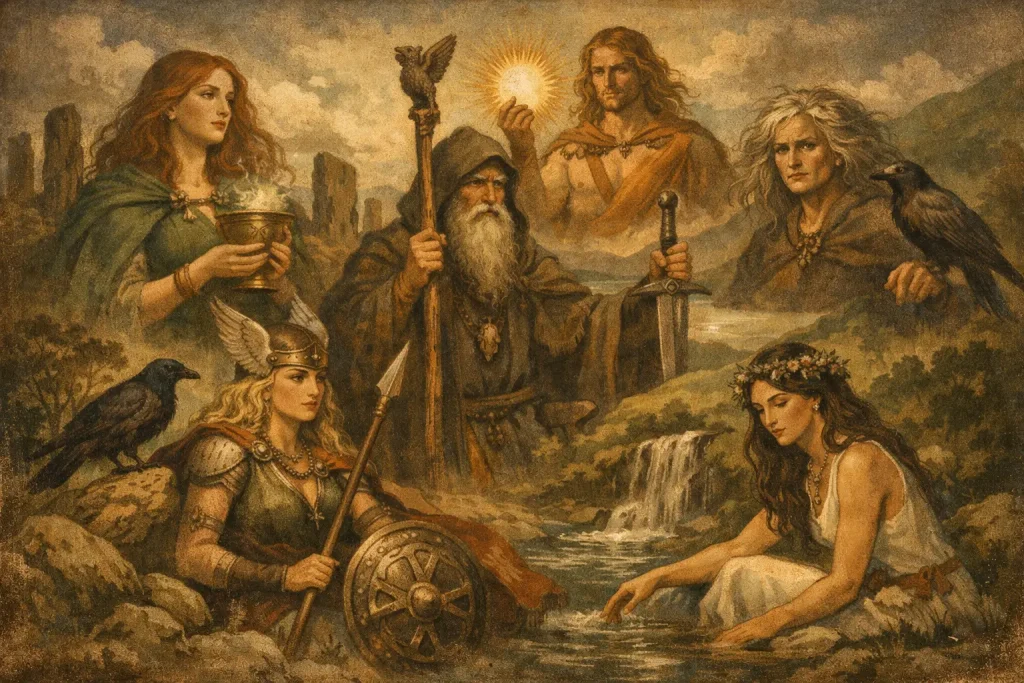
The gods and goddesses of Ireland are not distant figures locked in old books. They are woven through rivers, hills, burial mounds, wells, storms, cattle paths, poetry and fire. To meet them properly, you do not begin with a neat family tree or a tidy pantheon. You begin with the land itself, because in Ireland, divinity was never entirely separate from place.
This matters if you feel called to Ireland for reasons you cannot quite explain. Many do. They arrive thinking they are seeking history, and discover they are really seeking relationship. The old deities of Ireland are best understood not as characters from a dead religion, but as presences held in story, memory and sacred geography. A homecoming. A remembering.
Who are the gods and goddesses of Ireland?
When people speak of Irish deities, they are often referring to the Tuatha De Danann, the luminous ancestral beings of myth who came to Ireland in the deep past. They are described as skilled in magic, poetry, healing, craftsmanship, kingship and war. Yet even that description is only partly true, because the Irish tradition does not fit neatly into modern categories.
These beings are at once divine, ancestral and otherworldly. In some stories they are rulers. In others they are shape-shifters, teachers, lovers, poets or guardians of the land. After defeat by the Milesians, they are said to have withdrawn into the sidhe – the hollow hills and mounds… becoming the hidden people of the Otherworld. That tells you something essential. In Ireland, the sacred did not vanish. It simply moved behind the veil.
For modern seekers, that means caution is wise. It is tempting to flatten Irish mythology into a list of gods for love, war, healing or fertility. But the old tradition resists simplification. The deities of Ireland are layered, local and often contradictory. They ask for respect rather than easy labels.
The great goddesses of Ireland
Brigid
Brigid is among the most beloved of the goddesses of Ireland, and also one of the most enduring. She is associated with healing, poetry, smithcraft, sacred wells and the first quickening of spring. Her feast of Imbolc marks a threshold moment – the stir beneath the soil, the lambing season, the return of light that is felt before it is fully seen.
Brigid carries a rare kind of power. She is both fierce and gentle, domestic and initiatory. Fire and water belong to her. So does inspired speech. In Christian Ireland, she was woven into the figure of Saint Brigid, and for many people the two are not entirely separate. That blending does not weaken her. If anything, it shows how impossible she was to erase.
The Morrigan
The Morrigan is often reduced to a war goddess, but she is far more complex than that. She is linked with battle, yes, but also with sovereignty, fate, prophecy and the raw turning points of life and death. She appears at the edges of conflict as a crow or raven, watching, naming, unsettling.
To encounter the Morrigan in story is to be brought face to face with truth that cannot be prettied up. She does not soothe for the sake of comfort. She strips illusion. For those walking a spiritual path, her energy can feel challenging, even severe, yet deeply clarifying. She belongs to thresholds where an old self cannot continue.
Eriu, Banba and Fodla
Ireland itself is named for a goddess – Eriu. Alongside Banba and Fodla, she is one of a sacred triad associated with the land of Ireland. These are not decorative figures. They express something central in the Irish worldview: the land is alive, feminine, sovereign and not possessed by human beings.
In myth, invaders and kings must come into right relationship with the land if they are to rule justly. Sovereignty is not merely political. It is spiritual. Eriu, in particular, remains a powerful presence for those tracing ancestral belonging and asking what it means to be claimed by a place rather than to claim it.
The gods of Ireland and their powers
The Dagda
The Dagda is often called the good god, though not because he is morally perfect. Rather, he is good at everything that sustains life. He is a father figure, a keeper of abundance, a master of druidic power, a wielder of the club and cauldron. His cauldron leaves no one unsatisfied, and his harp can command the seasons and the emotions of the heart.
There is earthiness to the Dagda. He is not polished. He is powerful, sensual, practical and immense. He reminds us that sacred power is not always refined. Sometimes it is fertile, humorous and deeply embodied.
Lugh
Lugh is the bright many-skilled one – warrior, craftsman, poet, kingly presence and master of arts. His festival, Lughnasa, stands at the beginning of harvest and carries themes of skill, labour, offering and ripening. He is not only brilliance but disciplined excellence.
If Brigid is the spark of inspiration, Lugh is the honing of it into mastery. His stories speak to anyone called to make their gifts an offering. There is devotion in skill when it is aligned with service.
Manannan mac Lir
Manannan is the sea god, the keeper of boundaries and the guide between worlds. Mists, crossings, boats, horses, waves and the hidden realms all gather around him. In island consciousness, such a deity is no small thing. The sea is route, mystery, danger and initiation.
Manannan teaches that crossings require surrender. You do not command the liminal. You enter it with humility. For travellers arriving on Irish shores with a spiritual ache they cannot name, his presence often feels close – especially in the west, where land and ocean seem to speak across worlds.
Aengus
Aengus is linked with love, youth, beauty, dreams and poetic enchantment. Yet his stories are not merely romantic. They concern longing, transformation and the soul’s pursuit of what is most true. He belongs to the sweetness that can alter a life.
He reminds us that desire itself can be sacred when it is not reduced to possession. Some callings arrive as beauty before they arrive as understanding.
Why these deities still matter
To speak of the gods and goddesses of Ireland today is not to pretend we can fully reconstruct ancient Celtic religion. We cannot. Much was lost, much was changed, and much comes to us through medieval Christian scribes who preserved myth while reshaping it. That is worth saying plainly.
And yet the old beings still matter because they continue to live in story, folklore, place-names, seasonal rites and personal encounter. People still leave offerings at wells. They still feel something shift at Uisneach, on the Hill of Tara, at Brigid’s sacred places in Kildare, at cairns and springs and islands where the veil seems thin. Not everyone will name that shift in the same way. Some will call it imagination, some ancestry, some devotion, some the Otherworld. It depends on the person and the depth of their listening.
What matters is that Ireland does not yield herself fully to spectatorship. She asks for presence. The deities associated with her landscapes invite the same.
Meeting the gods and goddesses of Ireland through place
The deepest way to approach Irish deity is not as a collector of mythic facts but as a respectful pilgrim. Read the stories, yes. Learn the names. Notice the recurring symbols. But then go further. Sit by a holy well without needing a performance from it. Walk a hill in silence. Mark the turning of the Celtic year. Listen to local lore. Let the land teach slowly.
This is where pilgrimage differs from tourism. Tourism asks, what can I see here? Pilgrimage asks, what is this place asking of me? If you come to Ireland in that spirit, the old stories begin to breathe differently. Brigid is no longer just a figure in a tale. She is the warmth at the well, the prayer in the chest, the first stirring after a long inner winter.
For those who feel drawn into a more guided experience, Ancient Spiritual Tours Ireland holds space for that meeting with reverence, not spectacle. The point is never to consume the sacred. It is to enter into right relationship with it.
There is wisdom in approaching these old powers with both openness and discernment. Not every myth is literal. Not every feeling is revelation. But neither is everything mere metaphor. Ireland has always been a land where the visible and invisible lean close together.
If the gods and goddesses of Ireland call to you, let the call be slow. Let it ripen through story, weather, ritual and footfall on ancient ground. Some names are not learned all at once. They are remembered over time.