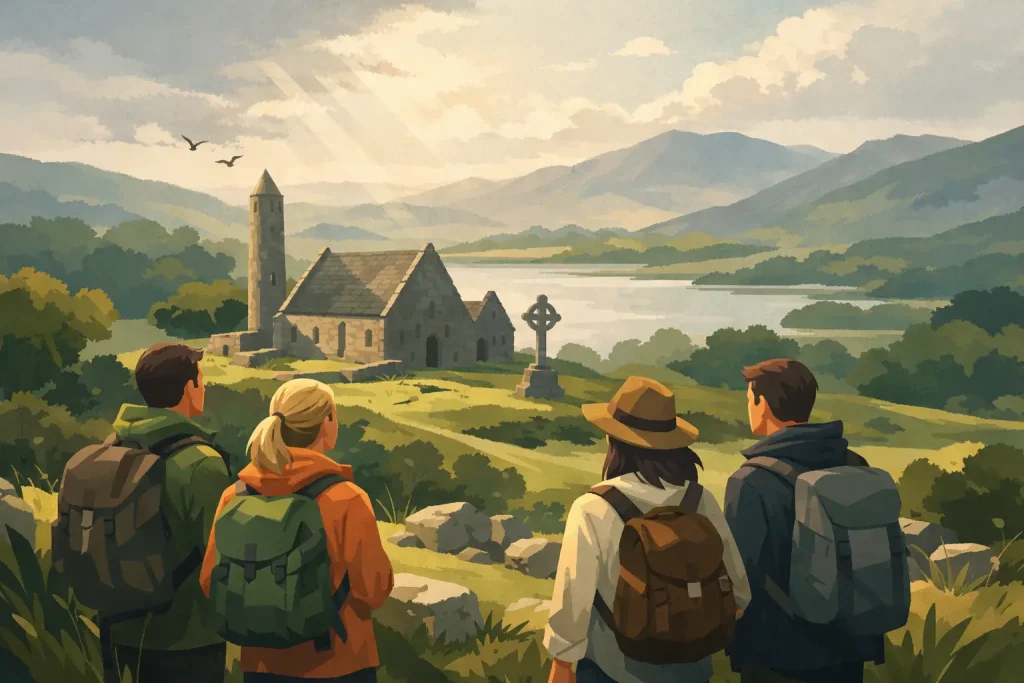
There is a world of difference between standing at a sacred well with twenty strangers jostling for a photograph and arriving there in stillness, with enough space to hear the wind move through the hawthorn. That is why small group pilgrimages Ireland seekers are drawn to are not simply a gentler version of coach travel. They are a different kind of crossing altogether – more intimate, more attentive, and far more capable of becoming a true act of remembrance.
This is not a tour. It is a pilgrimage. The land feels that difference, and so do you.
What makes small group pilgrimages in Ireland different
Ireland is filled with places that cannot be understood through facts alone. You can learn the date a monastery was founded, the legend tied to a mountain, the route kings once took to ceremonial centres. Yet knowledge on its own does not open the deeper door. Sacred places ask for slowness. They ask for presence. They ask for a quality of listening that is nearly impossible in a large, hurried group.
A smaller pilgrimage allows each place to reveal itself in its own time. At a holy well, there may be space for prayer, a blessing, or a moment of silence that is not rushed. On a hillside linked to the old festivals, there may be time to hear the story properly, to feel how the season sits in the body, and to take part in simple ritual without self-consciousness. This changes everything.
Large-scale tourism tends to treat Ireland as scenery, heritage, or entertainment. A pilgrimage asks something else. It asks you to arrive in right relationship – with the land, with the old stories, with your own inner life, and often with your ancestors as well. Small groups support that shift because they preserve the atmosphere needed for reverence.
Why the size of the group shapes the spiritual experience
There is a practical side to this, of course. Smaller groups can reach places that larger groups cannot access with ease. They can move more quietly, adapt to weather and energy, and spend longer where it matters. But the deeper value is not logistical. It is energetic.
In a small circle, people tend to soften. They speak more honestly. They are more willing to enter ceremony, reflection, or shared silence. A pilgrimage begins to feel less like a public event and more like a held container. For those coming to Ireland in a time of transition, grief, healing, or spiritual threshold, that sense of safety matters.
It also changes the role of the guide. In a large group, a guide often becomes a manager of timing and movement. In a smaller pilgrimage, they can become what they are meant to be – a steward of place, a keeper of context, and a bridge between the visible landscape and the older currents moving beneath it.
That is especially important in Ireland, where many sacred sites still live in local memory, folk practice, and oral tradition. The story of a place is rarely just what is on a signboard. Often, it is what is still whispered about it, what rituals remain, what warnings are remembered, and what blessings are still sought there.
Small group pilgrimages Ireland travellers often seek for ancestral reconnection
For many people, the call to Ireland is not casual. It arrives as longing, dream, grief, curiosity, or a sense of being drawn by something older than personal preference. This is especially true for the Irish diaspora, but not only for them. Some feel an ancestral bond. Others feel a spiritual recognition they cannot quite explain.
Small group pilgrimages Ireland offers can hold that complexity better than mainstream travel. They leave room for the personal story. You may come looking for roots, but find healing. You may come seeking Celtic spirituality, but discover a more grounded relationship with land itself. You may come with questions and leave with no tidy answers, only a stronger sense of belonging. That is often the more honest gift.
This kind of journey is not built around ticking off famous locations. It is shaped around encounters. A sacred hill at dawn. A fire ceremony near Bealtaine. A guided visit to an ancient site where myth, kingship, death and renewal still feel close to the surface. A conversation with a local wisdom keeper whose relationship to the place is lived, not performed. These are not interchangeable experiences. They ask for care in how they are held.
The role of ritual, story and season
Not all pilgrimages in Ireland are the same, and they should not be. Some are deeply connected to the Celtic Wheel of the Year, which means the timing of the journey matters as much as the route itself. Ireland in Samhain carries a different threshold energy from Ireland in Bealtaine. One leans towards endings, ancestors and the thinning veil. The other quickens with fertility, fire, blessing and emergence.
Small groups make it possible to honour that seasonal intelligence properly. A ceremonial experience linked to the land is difficult to do well if it feels staged or crowded. It needs sincerity, guidance, and enough intimacy that participants can actually enter into it rather than observe from the edge.
Story also lands differently in a small group. Irish myth is not meant to be delivered as dry information. It is alive with place, symbol and spirit. When shared in the right setting, it begins to work on the imagination in a deeper way. You do not simply hear about the goddess, the saint, the poet or the otherworld crossing. You begin to sense how these stories still shape the land beneath your feet.
Who small group pilgrimages in Ireland are best for
These journeys are not for everyone, and that is part of their strength. If what you want is speed, comfort without challenge, or a broad overview of Ireland’s major attractions, a conventional trip may suit you better. Pilgrimage asks more of you.
It is best suited to those who feel called rather than merely interested. People in midlife transition. Those carrying grief or seeking renewal. Healers, writers, therapists, spiritual practitioners, and seekers who are tired of polished experiences that leave the soul untouched. It also serves repeat visitors to Ireland who know there is more here than pubs, scenery and postcard history, but who need trusted guidance to meet that deeper layer with respect.
The trade-off is simple. A more intimate journey may include fewer locations, longer pauses, and less emphasis on comfort as performance. Yet what it offers in return is depth, coherence and meaning. You remember not just what you saw, but what shifted.
Choosing the right pilgrimage circle
Because the language of spirituality is easily borrowed, discernment matters. Not every journey described as sacred is truly rooted. Look for a pilgrimage shaped by relationship to the land, not by borrowed mystique. Ask whether the guides have real local knowledge, whether ceremony is approached with reverence rather than theatre, and whether the pace allows for genuine encounter.
A strong pilgrimage does not overpromise. It cannot guarantee revelation, healing, or transformation on demand. What it can do is create the conditions in which something real may happen. That honesty matters more than glittering language.
If a journey is connected to experienced local guides, seasonal ritual, sacred sites beyond the obvious circuit, and a clear spiritual framework, you are likely in safer hands. This is where a company such as Ancient Spiritual Tours Ireland can stand apart – not by offering spectacle, but by holding a path of depth, place-based wisdom and ceremonial integrity.
Why this way of travelling matters now
Many people arrive in Ireland carrying a quiet exhaustion. They are over-informed, over-connected and undernourished at the level that matters most. They do not need more stimulation. They need contact – with earth, prayer, beauty, ancestry, grief, song, mystery. They need space to feel their own life again.
That is why small group pilgrimage matters now in a way it perhaps did not a generation ago. It offers not escape, but reorientation. It brings people out of consumption and back into relationship. It reminds them that a journey can still be holy.
And Ireland, when met in the right way, responds. Not all at once, and not always gently. But with a depth that can be felt long after the road ends.
If you are being called towards sacred travel here, do not ask only where you want to go. Ask how you want to arrive. The answer to that question may shape the whole pilgrimage.