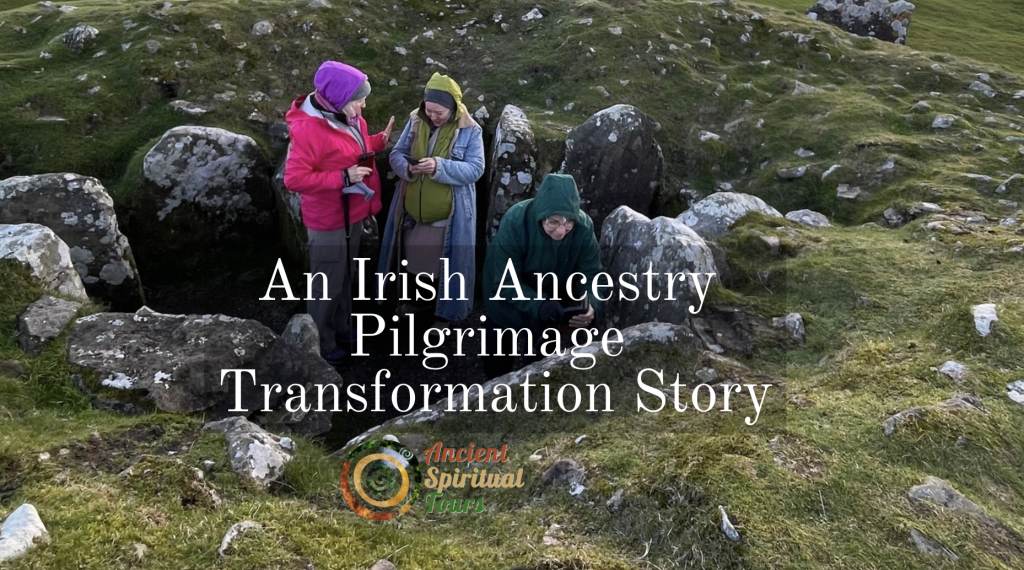
There is a particular moment that can arrive without warning: standing before an old holy well, a ruined church, or a stone circle, and feeling that Ireland is not entirely unfamiliar. The Irish ancestry pilgrimage transformation story often begins there. Not with a document, a surname, or a neat branch on a family tree, but with a felt recognition in the body. A loosening. A quiet grief. A sense that something long carried is asking to be met.
For many in the Irish diaspora, ancestry begins as research. Names emerge from parish records. A great-grandmother left Cork after a famine season. A grandfather never spoke of the family he left behind. The facts matter. They give shape to a story that may have been fragmented by migration, silence, loss, or the need to begin again elsewhere.
But facts alone cannot always answer the deeper call. They can tell us where someone was born. They cannot tell us what it means to stand on the same soil with an open heart, to hear a local story carried through generations, or to offer a prayer for those whose names are no longer known.
That is where pilgrimage begins.
When ancestry becomes a living encounter
An ancestry journey becomes transformative when it moves beyond the question, “Who were my people?” and enters a more searching one: “What relationship am I being asked to have with this inheritance now?”
Ireland holds memory in ways that are not confined to archives. It lives in place names, in holy wells tended with care, in old paths walked towards seasonal gatherings, in the rhythm of the Celtic calendar, and in stories still spoken close to the land. To encounter these places with reverence is not to claim a past that is not ours. It is to listen for the thread that connects personal history with a wider human story of belonging, rupture, resilience, and return.
This distinction matters. Ancestral connection can be deeply moving, but it is not a performance and it is not a commodity. Some people arrive with detailed records and a known family parish. Others come with only a surname, a family rumour, or a pull they cannot explain. Neither is more valid. The land does not demand proof before it asks us to be present.
For some, the transformation is a powerful sense of homecoming. For others, it is more complicated. A pilgrimage may bring sorrow to the surface: the cost of emigration, inherited silence, religious trauma, or the feeling of having been cut off from culture and kin. A meaningful journey makes room for this complexity. It does not force a tidy resolution.
An Irish ancestry pilgrimage transformation story is not always dramatic
The language of transformation can make us expect a single, life-altering revelation. Occasionally, that does happen. More often, change arrives quietly.
It may be the woman who carries a small photograph of her grandmother to a sacred spring and finally allows herself to mourn. It may be the man who has spent years tracing a family name and realises, in a circle of story and song, that he is grieving more than missing information. It may be someone with no confirmed Irish lineage at all, who discovers that the true call was towards a slower, more rooted way of living.
The turning point is rarely the site itself. Sacred places are not backdrops for a spiritual experience we have already decided to have. They ask something of us: patience, humility, attention. A place may offer no immediate feeling. Another may stir something so old it has no words. Both encounters can be honest.
This is why pilgrimage asks for time. It asks us to walk more slowly, to be quiet when quiet is needed, and to let ceremony give form to what may otherwise remain unspoken. Through ritual, storytelling, reflection, and respectful time on the land, ancestry begins to move from the mind into the lived texture of experience.
The land offers context, not a shortcut
It is tempting to seek certainty in ancestral travel. We want the exact cottage, the definitive story, the sign that says we belong. Sometimes those things can be found. Often they cannot.
A sacred journey offers something more enduring than certainty: context. It helps us see that our individual family story sits within the larger histories of Ireland – colonisation, famine, migration, dispossession, faith, language, survival, and renewal. This does not erase personal pain. It gives it a landscape in which to breathe.
A good guide will not invent connections or make extravagant claims about the energy of a place. They will hold the history, the local customs, the practical care required, and the spiritual openness needed for a genuine encounter. The difference is significant. One approach uses Ireland to decorate a personal narrative. The other lets the land challenge and deepen it.
Why ritual changes the journey
Ritual is one of the ways a pilgrimage becomes more than a series of meaningful moments. It creates a threshold between ordinary time and intentional time.
At a sacred well, a simple act of offering can become a way of naming what has been inherited and what need not be carried forward. Around a fire at Bealtaine, participants may reflect on what is ready to grow. In the inward-facing season of Samhain, remembrance can become a conscious conversation with those who came before. These practices are not theatre. Held with care and cultural respect, they offer a container for reflection that ordinary life often denies us.
The trade-off is that ritual requires participation. It cannot be consumed from a distance. Some people feel at ease with ceremony immediately; others need time, or may prefer silence and observation. There is no correct emotional response. What matters is consent, respect, and the willingness to meet the experience as it is rather than as it was imagined.
Small groups matter here. They allow space for personal reflection without turning private experience into spectacle. They make it possible to listen, to share if sharing feels right, and to be accompanied by others who understand that something real is unfolding.
Bringing the return home
A pilgrimage does not end when the plane leaves Ireland. In fact, the return home is often where its meaning becomes clearer.
After time in sacred places, people may notice that old habits no longer fit quite so comfortably. They may feel called to speak with a relative, learn a family song, create a remembrance practice, spend more time outdoors, or make a decision they had been postponing. These are not instructions from the land. They are invitations that arise when we have given ourselves enough quiet to hear what was already present.
The most grounded way to honour an ancestral journey is not to chase an endless peak experience. It is to carry one small practice into daily life. Light a candle for the known and unknown ancestors. Keep a journal of stories you do not want to lose. Mark the turning seasons. Ask better questions of your family, and listen without rushing to fill the silences.
This is exactly why we guide small, pilgrimage-led journeys across Ireland. Not to show you more places, but to help you meet them properly.
Through story, ritual, silence, and presence, the land is not explained from the outside. It is encountered from within. Ancient Spiritual Tours Ireland holds these journeys with reverence for the places themselves and for the people who arrive carrying questions, memories, and a call they may not yet understand.
This is not a tour. It is a different way of travelling entirely.
If your ancestry has become more than a search term, if Ireland feels less like a destination and more like a threshold, explore our sacred journeys through Ireland. Come without needing to have the whole story resolved. Sometimes the truest homecoming begins with the willingness to listen.