There is a particular kind of light in Ireland at Bealtaine. Hedgerows loosen into blossom, the evenings lengthen, and the land seems to exhale after the inward pull of winter. To speak of a Bealtaine pilgrimage Ireland experience is to speak of more than seasonal travel. This is not a tour. It is a threshold crossing into the old fire festival of summer, where renewal is not an idea but something felt in the body, the breath, and the bones.
For those called to Ireland through ancestry, spirit, or a quieter form of longing they cannot quite name, Bealtaine carries a distinct summons. It marks the ancient turning when the dark half of the year gives way to growth, sensuality, vitality and blessing. Historically, cattle were driven between two fires for protection. Homes were purified. Wells were visited. The people entered the new season through ritual, not abstraction. That old pattern still matters, because the soul does not thrive on information alone. It needs ceremony. It needs place. It needs moments that make change real.
Why a Bealtaine pilgrimage in Ireland feels different
Many journeys to Ireland are beautiful. Few are initiatory. A true Bealtaine pilgrimage in Ireland asks something deeper of the traveller than appreciation or curiosity. It asks for presence. It asks you to arrive not as a consumer of landscape, but as someone willing to be in relationship with it.
That distinction changes everything. Sacred sites are no longer stops on an itinerary. They become living presences within a much older field of memory. A holy well is not merely picturesque. A hill is not merely scenic. A fire ceremony is not a performance. Each becomes part of a spiritual grammar that the land still speaks, if approached with humility.
This is why Bealtaine can be so potent for people in midlife, in transition, or at the edge of change. The festival belongs to ripening, emergence and life force, but it does not ignore what must be shed. To step fully into the season, something often has to be released first – grief, numbness, a stale identity, a pattern of over-giving, a life built too long around survival. The blessing of Bealtaine is generous, but it is not vague. It tends to illuminate where you have gone dormant.
The old festival and its living meaning
In the old Irish calendar, Bealtaine marks the beginning of summer. It sits opposite Samhain, the feast of descent, ancestors and the thinning veil. Where Samhain turns us inward, Bealtaine turns us outward. Fire, fertility, beauty, erotic aliveness, growth and protection all gather around it.
Yet Bealtaine is often misunderstood if reduced to fertility alone. Its deeper current is consecrated vitality. It asks not simply, What do you want to create? but also, What in you is ready to come into fuller, truer life? That can apply to relationships, creativity, healing, spiritual vocation, ancestral belonging or the courage to become visible again after years of diminishment.
In Ireland, this meaning is inseparable from place. The old customs were rooted in actual fields, actual hills, actual wells and community ritual. That matters because spiritual experience without grounding can become sentimental very quickly. Ireland holds a different possibility. The mythology, the seasonal rites, the local traditions and the physical landscape still touch each other. When they are approached with care, you are not merely learning about Bealtaine. You are entering its field.
What happens on a Bealtaine pilgrimage Ireland journey
No two sacred journeys unfold in exactly the same way, and that is part of their integrity. Pilgrimage is not manufactured for uniform results. One person may experience deep grief breaking open into relief. Another may feel ancestral recognition. Another may simply notice, perhaps for the first time in years, what it is to feel rested, clear and inwardly alive.
Even so, there are certain elements that belong naturally to a Bealtaine path. Fire is one of them. In ritual terms, fire clarifies, blesses, protects and activates. To gather around ceremonial fire at this turning point is to enter an ancient pattern of purification and welcome. It can mark the end of one chapter and the consecration of another.
Sacred water often sits beside sacred fire. Holy wells have long been places of prayer, healing and offering in Ireland. During Bealtaine, they can carry a special tenderness. Water receives what the heart cannot always say aloud. It steadies. It softens. It remembers. The movement between fire and water is not accidental – it mirrors the soul’s need for both transformation and mercy.
Pilgrimage may also include visits to ancient ceremonial landscapes, stone circles, hilltops, monasteries, and sites where myth and devotion still feel close to the surface. Storytelling has a rightful place here too. Not entertainment, but the old way of transmitting wisdom through image, lineage and place-based memory. When myth is spoken on the land that birthed it, something in the listener often stirs awake.
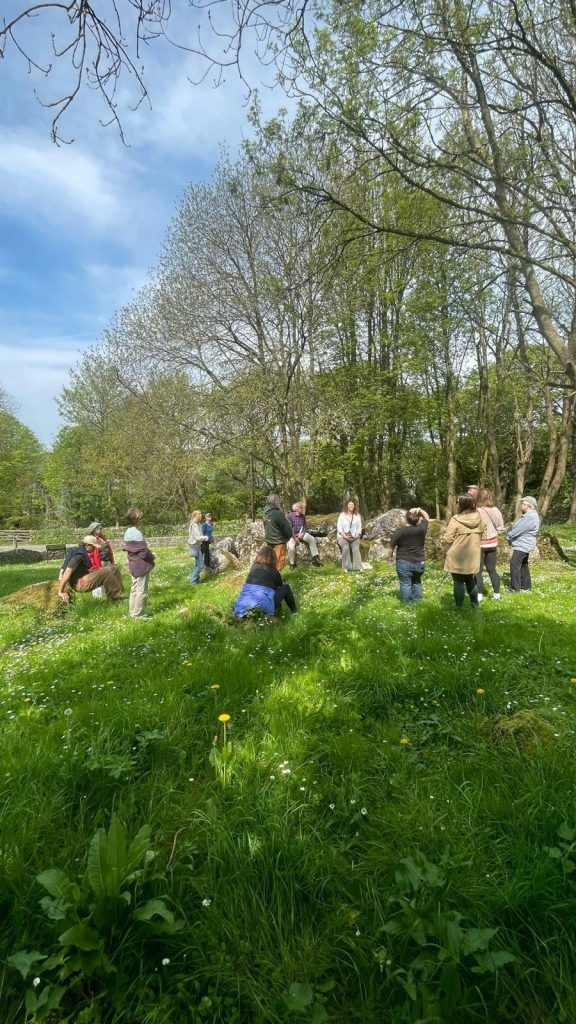
There is also the often-overlooked gift of being held in a small group of fellow seekers. This can be surprisingly healing. Many spiritually sensitive people have spent years feeling out of step with mainstream culture – too intuitive, too devoted to mystery, too hungry for depth. Pilgrimage creates a different kind of company. Not everyone arrives with the same beliefs, but there is often a shared reverence that allows people to soften their guard.
Who feels called to Bealtaine
The call does not usually arrive as logic. It arrives as a pull. Sometimes it is connected to Irish ancestry and a longing to return in a way that is more intimate than heritage tourism. Sometimes it comes after burnout, bereavement, divorce, menopause, illness or a major life redirection. Sometimes it comes because the old life still functions outwardly, yet inwardly something has gone quiet and wants tending.
Bealtaine tends to speak strongly to those who are ready to come back into relationship with their own vitality. Not performative positivity. Not pressure to be endlessly productive. Something older and more rooted than that. A sense of being alive in right relationship with the body, the earth, the season and the soul’s own timing.
That said, it is worth being honest about readiness. A pilgrimage is not a wellness weekend dressed up in Celtic language. It can be beautiful, joyful and deeply nourishing, but it can also be emotionally exposing. The land has a way of bringing truth close. For many, that is exactly the medicine. For some, timing matters, and gentleness with oneself is part of the path.
Bealtaine pilgrimage Ireland as remembrance, not escape
One of the quiet misconceptions around spiritual travel is that people are trying to get away from life. In sacred journeying, the opposite is often true. The deeper purpose is to return to life differently – more aligned, more honest, more able to carry what is essential.
That is what makes a Bealtaine pilgrimage Ireland experience so powerful when held with authenticity. It is not escape into fantasy. It is remembrance. A homecoming. A remembering. You remember that the year has sacred turning points. You remember that land can participate in healing. You remember that ritual is not an indulgence but a human need. You remember that your life, too, asks to be blessed, protected and brought into right relationship.
At Ancient Spiritual Tours Ireland, this is the heart of the work: journeys shaped not as sightseeing but as soul-led pilgrimage through sacred Irish landscapes, guided by ritual, story and the wisdom of those who know the land as living presence.
What to look for in a true Bealtaine pilgrimage
Because spiritual language is now used very freely in travel, discernment matters. A meaningful pilgrimage should feel grounded in place, lineage and reverence rather than packaged mystique. There should be a clear relationship to the season itself, to Irish sacred sites, and to guides who understand both the spiritual and cultural weight of what is being offered.
It should also leave room for mystery. Not everything sacred can be over-explained or forced into instant transformation. The strongest experiences are often the least performative. A quiet moment at a well. Wind on a hill. The smell of smoke in evening light. A prayer you did not expect to say. These can carry more lasting change than anything dramatic.
If Bealtaine is calling you, trust that call enough to meet it with respect. Read slowly. Listen inwardly. Notice whether what you seek is novelty or initiation, escape or relationship, inspiration or true renewal. The land of Ireland has long been a keeper of thresholds. At Bealtaine, it opens one of its brightest.
And if you cross it well, you may find that what returns with you is not just memory of a journey, but a steadier flame for the life waiting at home.