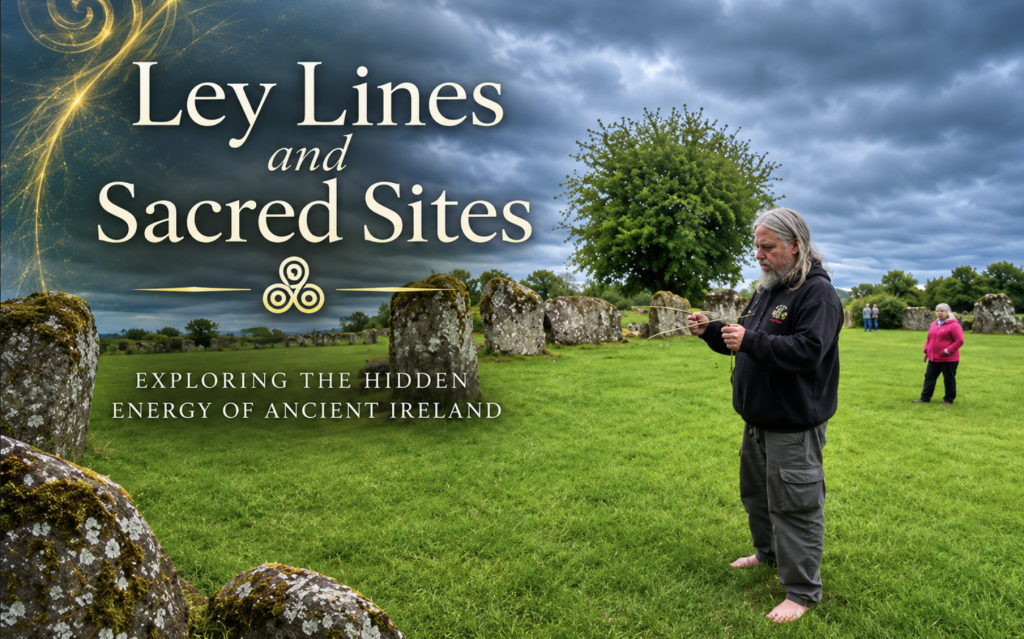
Some places in Ireland do not feel merely old. They feel awake. You step onto a hill, pass through a stone circle, stand at the mouth of a passage tomb, and something in your body knows before your mind can explain it. That is often where the conversation around ley lines Ireland begins – not with theory, but with sensation. A hum in the chest. A sharpening of silence. A feeling that the land is not inert, but in relationship.
For many people drawn to Ireland for spiritual reasons, ley lines offer a language for something they have already sensed. They suggest that sacred sites are not isolated monuments scattered by chance, but part of a larger pattern – currents of energy, alignment, memory, and intention woven through the body of the land. Whether one takes that literally, symbolically, or somewhere in between, the deeper truth remains compelling: Ireland has long been understood as a living sacred landscape.
What are ley lines, really?
The modern idea of ley lines is often traced to the early 20th century, when alignments between ancient sites began to be discussed as possible purposeful tracks or straight pathways. Over time, especially within spiritual circles, the concept expanded. For some, ley lines are energetic channels linking holy wells, standing stones, ring forts, mountains, monasteries, and burial sites. For others, they are less like invisible wires and more like pathways of consciousness – routes where devotion, ritual, seasonal observation, and ancestral presence have been layered over centuries.
That distinction matters. If we speak too rigidly, we flatten the mystery. Not every straight line on a map is sacred. Not every sacred place needs to sit upon an energetic grid to hold power. Ireland does not need modern spiritual theory imposed upon it to become mystical. It already is.
What makes the Irish landscape extraordinary is not simply the possibility of alignments, but the continuity of reverence. Mountain summits, riverbanks, island hermitages, ancient ceremonial sites and early Christian holy places often carry older presences beneath newer names. The land remembers. The people remembered with it.
Ley lines in Ireland and the older sacred map
When people search for ley lines in Ireland, they are often really searching for Ireland’s hidden spiritual architecture. They want to know why certain places feel charged, why pilgrimage routes still stir the heart, why so many of the island’s ancient sites seem to speak to one another across distance.
In Ireland, the sacred map was never only geographical. It was seasonal, mythic, and ceremonial. The old festival points of Samhain, Imbolc, Bealtaine and Lughnasa shaped how communities moved through the year. Hills such as Tara, Uisneach and Tlachtga were not simply landmarks. They were ritual centres, places of kingship, fire, offering and transition. Passage tombs like Newgrange and Cairn G are aligned with solar events in ways that reveal profound attentiveness to cosmos and cycle.
If one wishes to understand ley lines here, it is wise to begin with this older worldview. Ancient Ireland was not laid out according to convenience. It was oriented through meaning. Sites were chosen for visibility, fertility, celestial relationship, territorial significance, and spiritual potency. Some alignments may indeed reflect deliberate placement. Others may emerge because sacred builders were attentive to the same hills, watersheds, horizons and thresholds generation after generation.
That is why the conversation is richer when it moves beyond a simple question of whether ley lines can be scientifically proved. Sacred landscapes are not laboratories. They are relational fields. What matters is how place, story, ritual and perception meet.
Why certain Irish sites feel charged
There are places in Ireland where people regularly report a palpable shift in awareness. Uisneach, often called the sacred centre of Ireland, is one of them. So is Tara, with its layered associations of sovereignty and ceremony. The Burren holds its own stark intelligence. Sligo’s limestone hills and cairns carry a wild, mythic gravity. On the islands, especially where sea and stone meet in elemental simplicity, many feel stripped back to something essential.
This does not mean every experience is dramatic. Sometimes the land works more quietly. A deep settling. Tears without a story. A sudden clarity around grief, ancestry, or direction. Spiritual seekers can be tempted to chase spectacle, yet Irish sacred sites often offer something subtler and more enduring – remembrance.
There are practical reasons some places feel potent. Geology affects atmosphere. Elevation changes perception. Sound behaves differently among stone. Open horizons alter the nervous system. Repeated ritual over centuries leaves cultural and psychological imprint. And for those who work in energetic or ceremonial traditions, there is also the felt sense that some sites are true power places, where earth energy gathers and moves with unusual force.
It depends, too, on how you arrive. If you come rushed, taking photographs and ticking off locations, the land may remain closed. If you come slowly, listening, offering attention rather than extraction, a site can reveal itself in a very different way.
How to approach ley lines Ireland without reducing the mystery
There is a modern habit of wanting the sacred explained too quickly. We ask for maps, coordinates, certainty. We want to know the line, the node, the proof. Yet Ireland resists being reduced to a diagram.
A wiser approach is to hold both discernment and openness. Yes, be cautious of dramatic claims made without depth or local understanding. There is plenty of projection in spiritual tourism, and plenty of imported language that can blur rather than clarify what is genuinely Irish. But do not let scepticism harden into numbness. Some things are known through the body, the dream, the prayer, and the ceremony.
If you feel called to explore this dimension of Ireland, begin with presence. Visit fewer places, not more. Learn the lore of the site. Notice the watershed, the horizon, the wind direction, the relation between hill and plain. Arrive at dawn if you can. Keep silence for a while. Touch the stone only where appropriate and with care. Offer gratitude rather than demand experience.
The sacred is not content. It is encounter.
Pilgrimage is different from sightseeing
This is where many travellers feel the true threshold. To visit Ireland’s ancient sites as attractions is one thing. To walk them as part of a devotional journey is another entirely. A pilgrimage does not ask, “What can I see here?” but “Who am I in the presence of this place?”
For spiritually curious travellers, this shift changes everything. A stone circle becomes not a relic but a chamber of attention. A holy well becomes not a quaint stop but a place of prayer and repair. A hilltop becomes not a viewpoint but an altar.
This is also why guided spiritual journeys can matter so deeply. When approached with integrity, local knowledge, and ceremonial respect, they help travellers meet the land in right relationship. Not as consumers of mysticism, but as participants in an older conversation. At Ancient Spiritual Tours Ireland, that is the heart of the work – not to package mystery, but to help people enter it reverently.
The real invitation of Ireland’s sacred lines
Perhaps the most useful way to think about ley lines is not as fixed corridors to be hunted down, but as invitations to attunement. The line may be energetic, ancestral, ceremonial, or mythic. It may run through the land, through old routeways, through song, or through your own blood memory. For those of Irish lineage, this can feel like a homecoming. For others, it may feel like being welcomed into an ancient pattern larger than the self.
And there is humility in that. We do not need to master the land’s mysteries to be changed by them. We only need to approach with sincerity.
Ireland’s sacred terrain asks for patience. It asks you to let go of the need to decode everything. Stand where the fire festivals were once lit. Walk where pilgrims walked. Sit beside the well, the cairn, the yew tree, the sea-cliff chapel. Feel what stirs. Let the land speak in its own tongue.
Some lines are drawn on maps. The deeper ones are drawn through the soul.
If ley lines in Ireland call to you, let that call make you slower, quieter, and more attentive. The greatest gift of the sacred landscape is not explanation. It is relationship.