On a cold evening at the turn of November, a fire in Ireland does more than push back the dark. It gathers people at a threshold. Fields have yielded what they can. The brightness of summer has withdrawn. The year seems to pause, asking for silence before it begins again.
Samhain Ireland is often spoken of as Halloween’s ancient source. That is only one small part of the story. Samhain is a seasonal turning, a meeting place between harvest and winter, visibility and mystery, the known world and all that lies beneath it. For many people who feel called to Ireland, it carries a particular charge: an invitation to remember that endings are not failures, but necessary ground for renewal.
This is not a date to consume from the outside. It is a threshold to meet with attention.
What Samhain means in Ireland
Samhain, traditionally marked from sunset on 31 October into 1 November, stands opposite Bealtaine in the Celtic Wheel of the Year. Bealtaine opens the bright half of the year. Samhain ushers in its darker half. In an agricultural society, this was a practical turning as much as a spiritual one. Animals were brought in from summer pasture, stores were assessed, and communities prepared for the long winter ahead.
Yet the old Irish tradition holds more than seasonal housekeeping. Medieval Irish literature places Samhain among the great quarter days of the year, a time when kings gathered, agreements were renewed and the ordinary order of things could become unstable. Tales tell of the sídhe, the Otherworldly beings associated with ancient mounds and places beyond the everyday, drawing near. The boundary was thought to be thinner.
We should be careful not to flatten this into a neat modern slogan. No one can fully reconstruct how every community observed Samhain centuries ago, and living folk practices have changed with place, faith and family. But the core recognition remains powerful: at certain times, the land itself teaches us to cross gently. To give thanks. To protect what must be protected. To honour those who came before. To make room for what cannot be hurried.
Samhain in Ireland is not just Halloween
Halloween carries real traces of older seasonal customs, including disguising, visiting homes, divination games, carved lanterns and the communal fire. In Ireland, turnip lanterns were once common, their fierce faces a far cry from the smooth orange pumpkins now associated with the season. Families also kept customs that were local and intimate, shaped by parish, townland and memory.
But Samhain is larger than its modern festivities. When the season is reduced to costumes and fright, its deeper human wisdom can be missed. The dark is treated as something to decorate, rather than something to sit beside.
A pilgrimage approach does not require anyone to reject celebration. It asks a different question: what is this season bringing to the surface in you? Perhaps it is grief that has been waiting for witness. Perhaps it is a life chapter that is complete, though no outward ceremony has marked it. Perhaps it is an ancestral thread, a creative work, or a longing for belonging that has become too strong to ignore.
Samhain does not promise easy answers. It offers a fitting atmosphere for honest ones.
Fire, ancestors and the sacred landscape
Fire sits at the heart of many Samhain memories and traditions. It carries warmth, protection and communal presence. Across the Celtic year, fire festivals marked moments of transition, but at Samhain the flame has a distinctive quality. It is lit as the world enters its inward season, when daylight shortens and the work of the soul becomes less visible.
In ceremonial practice today, a fire may become a place to name what is ending and what must be released. That is not historical re-enactment. Nor is it a performance of imagined Celtic identity. Held with care, it is a contemporary act of relationship with an ancient seasonal rhythm.
Ancestral remembrance belongs here too. In Ireland, the past is not confined to books or museums. It lives in family stories, in burial grounds, in place names, in the ruins that remain close to fields still worked today. For members of the Irish diaspora, Samhain can stir a complicated kind of recognition. The pull may be deeply felt, even where records are incomplete or family history has been broken by migration, loss or silence.
There is no need to invent a lineage in order to be moved by the land. A respectful encounter begins with listening. It may include speaking the names you know, giving thanks for those whose names have been lost, and acknowledging that ancestry carries both gifts and wounds. The aim is not certainty. It is relationship.
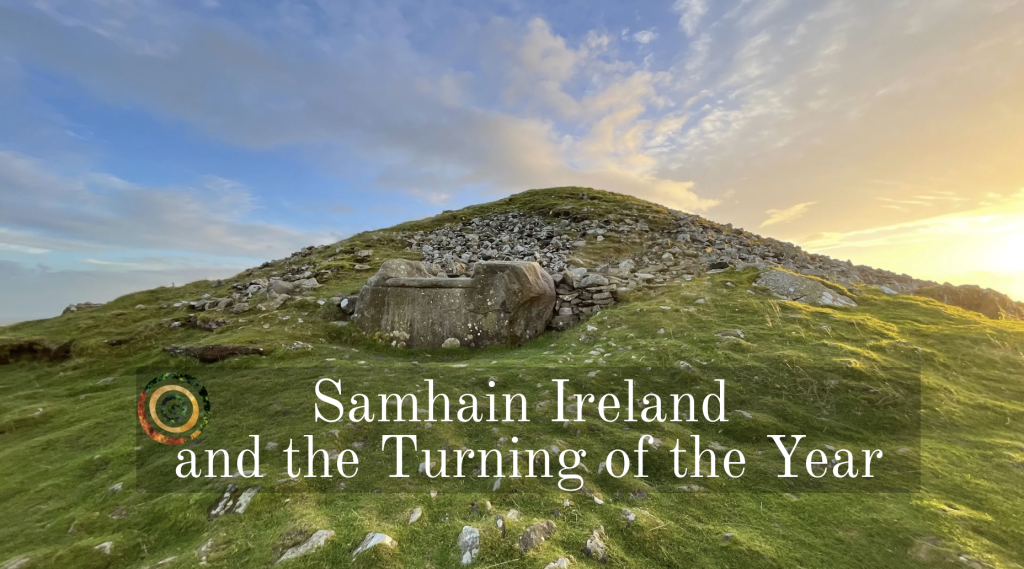
Ireland’s ancient sites can hold this work with unusual force, particularly when approached slowly. A passage tomb, holy well, stone circle or hilltop is not simply a backdrop for private transformation. Each has its own history, ecology, folklore and local context. Some places welcome quiet reverence; some are vulnerable; some are not appropriate for ceremony at all. Good guidance means knowing the difference.
The discipline of crossing a threshold
Modern life rarely gives us space to finish one season before beginning the next. We move from urgency to urgency, carrying old demands into new chapters. Samhain offers a counter-movement. It asks us to pause before the rush towards year-end celebration and the false brightness of constant productivity.
That pause can be uncomfortable. Winter does not offer the same outward abundance as summer. It asks for discernment: what will sustain you, what needs tending, and what has reached its natural end?
For some, this is best met alone, with a candle, a journal, a walk at dusk or a simple meal shared in gratitude. For others, solitude can become another way of avoiding what needs to be witnessed. A small circle, held with skill and sincerity, can give shape to a transition that has been difficult to name. The right form depends on the person and the moment.
What matters is presence. Ritual without attention becomes decoration. Intention without action becomes wishful thinking. But when a gesture is rooted in place, season and truth, even something simple can become a crossing.
Why a Samhain pilgrimage belongs in Ireland
Reading about Samhain can awaken something, but the season is understood differently when you stand within it. The damp earth underfoot. The early dark over a sacred hill. The sound of a story spoken where the land has carried it for generations. These are not details added for atmosphere. They are part of the teaching.
This is exactly why we guide small, pilgrimage-led journeys across Ireland. Not to show you more places, but to help you meet them properly.
Through story, ritual, silence and presence, the land is not explained from the outside. It is encountered from within. A carefully held Samhain journey can bring together sacred sites, local wisdom keepers, ancestral reflection and ceremony without pretending that the past is a costume to be worn. It makes room for personal change while staying answerable to the land itself.
At Ancient Spiritual Tours Ireland, the Samhain experience is shaped as a true seasonal pilgrimage. There is time to listen rather than rush, to share without spectacle, and to let Ireland meet you in the way it meets each person differently. For some, that meeting feels like grief finally given a place. For others, it is a homecoming. A remembering. For many, it is simply the beginning of a more honest conversation with their own life.
This is not a tour. It is a different way of travelling entirely.
If Samhain Ireland has stirred something in you, do not rush to explain it away. Some callings arrive quietly, like the first smoke rising into a darkening sky. They ask only that you stop, listen, and take the next true step.