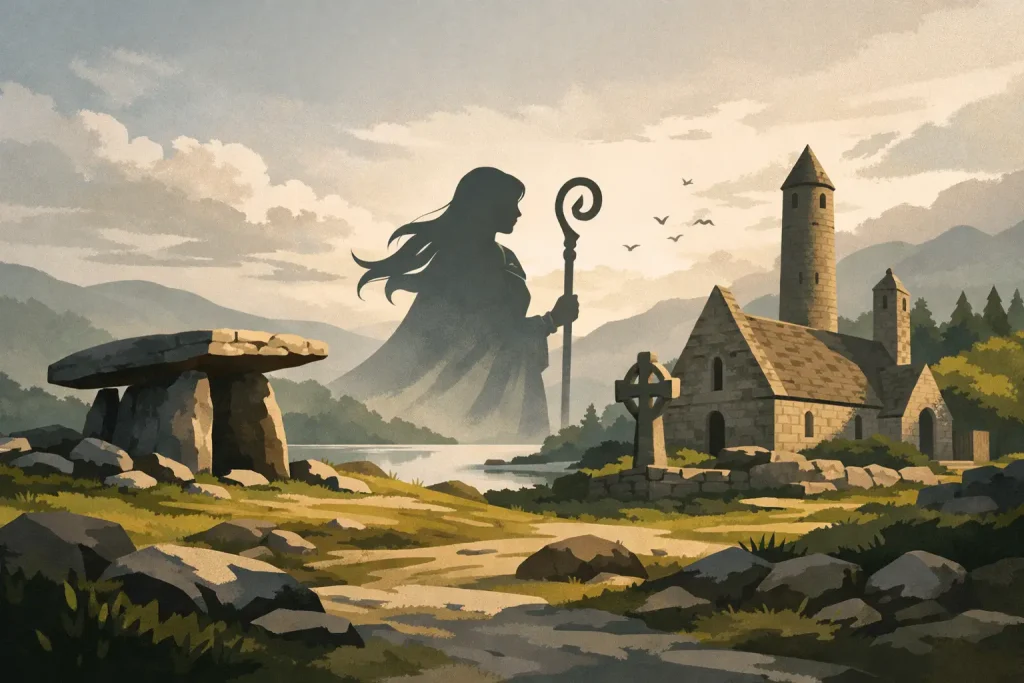
The first time you stand before an Irish megalith in the half-light, something in you goes quiet. Not because the place is empty, but because it is full – of memory, weather, prayer, and a presence older than explanation. Megaliths, myths and monasteries are not separate chapters in Ireland’s story. They are part of one living sacred continuum, written across the land in stone, story and devotion.
This matters if you are coming to Ireland for more than scenery. If you feel called by ancestry, by the old gods, by the saints, by dreams you cannot quite name, then the landscape asks something different of you. It does not ask to be consumed. It asks to be entered with reverence.
Megaliths, myths and monasteries as one sacred map
Mainstream travel often splits Ireland into neat categories. Prehistoric sites belong to archaeology. Myths belong to folklore. Monasteries belong to church history. That way of seeing may be useful in a classroom, but it does not reflect how the land is actually experienced.
In Ireland, sacred places rarely stay in one box. A hill may be linked to a goddess, crowned by a cairn, and later blessed by Christian devotion. A holy well may carry the presence of a local saint while still holding older associations with healing, fertility or the spirit of the place itself. The layers are not mistakes. They are part of the genius of the land.
This is why so many people feel unexpectedly moved here. You are not standing in front of a dead monument. You are standing inside an accumulated field of meaning. Every generation has added prayer, ritual, fear, hope and ceremony. The site has not finished speaking.
The language of stone
Ireland’s megaliths do not shout. They endure.
Portal tombs, passage tombs, standing stones and stone circles carry a grammar older than written record. Their alignment with sun, moon, season and horizon tells us these were not random structures placed for convenience. They emerged from people who lived in relationship with sky and soil, darkness and return. They understood that time was not merely counted. It was honoured.
When you visit a place such as Newgrange, Carrowmore or the Burren’s quiet stone fields, the temptation is to ask for proof. What was this exactly? Who used it? What did they believe? These are fair questions, but they can also narrow the encounter. Some things can be studied without being exhausted by study.
A megalith can be burial chamber, observatory, ceremonial site and threshold all at once. It can hold the practical and the mystical together. In that sense, these places still teach us. Modern life trains us to separate utility from sanctity. The old stone sites suggest another way – that daily life, death, cosmos and spirit belong to the same fabric.
For a pilgrim, this changes how one arrives. You do not come merely to look. You come to listen with the body. To notice the wind. To feel what happens in your chest when you cross a threshold or circle a stone sunwise. Not every person will feel the same thing, and not every site opens in the same way. That is part of the honesty of pilgrimage. The land is not a performance.
Why myth still matters
Myth is often treated as if it means fiction, as though a myth is a story we once believed before we became sensible. Ireland asks for a deeper reading.
Here, myth is not an escape from reality. It is one of the oldest ways of speaking about reality. The Morrigan at the river crossing, Brigid at the well and the flame, Lugh at the harvest, Cailleach in winter stone – these presences are woven into place. They tell us how the people of this island understood power, change, sovereignty, grief and renewal.
A myth does not need to be historically provable to be spiritually true. It carries pattern. It gives shape to experiences that reason alone cannot hold. Exile. Initiation. Death before rebirth. The testing of the soul. The restoration of balance. These are not antique concerns. They are human ones.
This is why certain Irish sites stir people so deeply. A mountain linked to an ancient goddess or a cave tied to descent and transformation can call forward something personal. You may arrive thinking you are interested in Celtic lore and leave realising the story has been reading you.
There is a trade-off here, and it matters. If myth is approached only romantically, it becomes decoration. If it is approached with fear or rigid literalism, it can become closed. The more fruitful path is reverent imagination – grounded enough to respect tradition, open enough to receive meaning.
The monasteries and the prayer that stayed in the stones
Then there are the monasteries – Skellig ledges swept by salt wind, ruined abbeys in green valleys, round towers rising from monastic settlements, high crosses weathered by centuries of touch and rain. These places hold a different current, but not a separate one.
Early Irish monasticism was often closer to pilgrimage, austerity and intimate relationship with the natural world than many people expect. The monks and nuns who settled in remote and elemental places were not fleeing the world so much as seeking God through a more direct encounter with creation, silence and discipline. Their cells, oratories and boundary walls still carry that intention.
To walk among monastic ruins is to feel prayer made visible. Stone becomes devotion. Layout becomes theology. The repeated turning of the hours, the labour of hands, the copying of sacred texts, the ringing of bells into mist – all of it leaves an imprint.
Yet even here, Ireland resists easy division. Many monastic sites arose in places already recognised as powerful. Christianity did not appear on a blank map. It entered a spiritually alive landscape and, in many cases, built upon ancient sacred ground. This does not reduce the monasteries. It deepens them.
For some travellers, this is where healing begins. Those who feel estranged from institutional religion but still hunger for the sacred often find that Irish monastic places offer a gentler threshold. The ruins do not demand belief. They invite contemplation. They make room for grief, longing and return.
Pilgrimage asks more than sightseeing
To move through megaliths, myths and monasteries in Ireland as a pilgrim is to accept that not every journey will be comfortable. Sacred travel can console, but it can also unsettle. One site may fill you with tenderness. Another may expose an old sorrow you thought had long been buried.
That is why intention matters more than itinerary. The same place visited as a quick stop and visited in ceremony can feel entirely different. Pace matters. Silence matters. Story matters. So does the quality of guidance.
There is a real difference between information and initiation. Information tells you what happened here. Initiation asks what is happening in you because you are here. Both have value, but they are not the same experience.
This is the heart of the work at Ancient Spiritual Tours Ireland. Not tourism dressed up in spiritual language, but land-rooted pilgrimage guided with respect for the old ways, the local stories, and the living mystery of place. For many, that difference is everything.
Megaliths, myths and monasteries in a time of disconnection
Part of why Ireland calls so strongly now is that so many people are tired of flat, hurried living. They are full of noise and starved of meaning. They do not need another packed itinerary. They need encounter.
The old sacred sites answer this hunger because they restore scale. A standing stone reminds you that your life is brief and holy. A myth reminds you that your struggle has pattern. A monastery reminds you that devotion can be built day by day, even through hardship.
None of this means idealising the past. Ancient cultures had their own violence, limits and contradictions. Sacred sites can be protected badly, interpreted poorly, or crowded by modern demand. Not every visitor comes in reverence. It is wise to hold both the beauty and the complexity.
Still, the land remains generous. If you come with humility, it meets you. If you come willing to slow down, it reveals more. And if you come because something in you is seeking a homecoming, Ireland has a way of answering through stone, through story, through the remains of prayer.
You do not need to solve every layer of the mystery. You only need to let yourself be changed by it, a little at a time, as you walk.