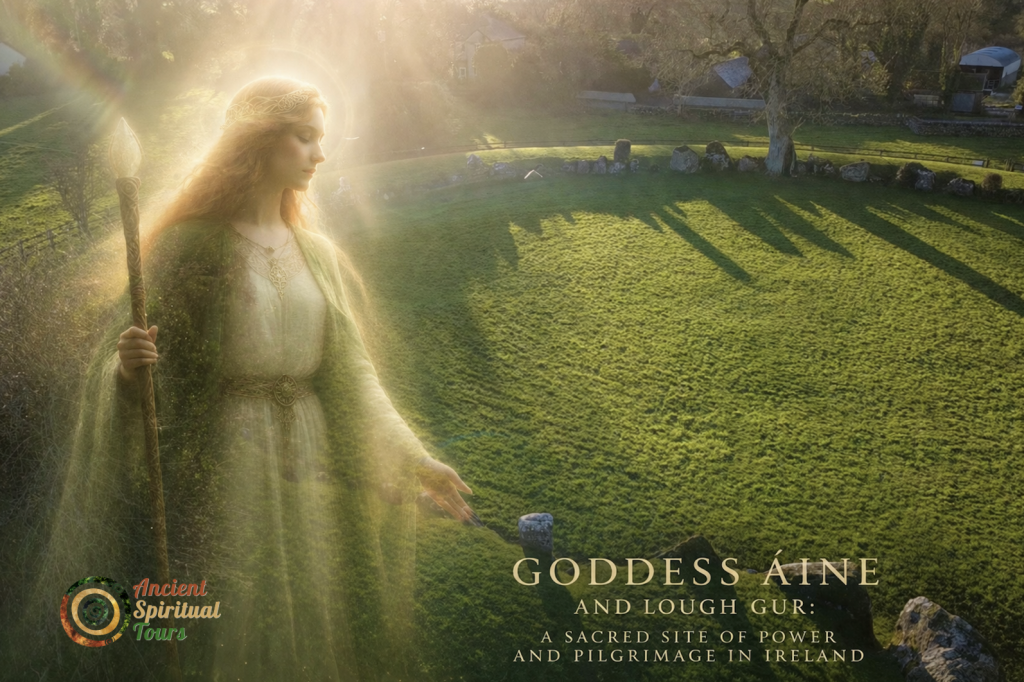
Stand at Lough Gur in the soft hush before rain, and the place does not feel silent at all. It feels listening. This is why the story of Goddess Áine and Lough Gur has endured for centuries – not as a relic of folklore, but as something still alive in the land, in memory, and in those who arrive here feeling called rather than curious.
Reading about places like this is one thing. Standing here is something else entirely.
Lough Gur, in County Limerick, is one of Ireland’s great sacred centres. People often speak of its beauty first, and it is beautiful, but beauty is not the deepest thing happening here. This is a place of old ceremony, of threshold energy, of sovereignty, of the hidden world pressing close. To come here only for a pleasant walk is to meet the surface. To come in reverence is different. Then the place begins to answer.
Goddess Áine and Lough Gur in Irish memory
Áine is one of the great figures of Irish tradition – a goddess associated with summer, fertility, sovereignty, abundance, and the bright force of life itself. She is often linked with the sun and with the turning of the year, especially around midsummer and the old fire traditions of Munster. Yet Áine is never only gentle. Like many of Ireland’s sacred feminine figures, she carries both blessing and power. She nourishes, but she also demands right relationship.
Her presence around Lough Gur is woven through local lore and older mythic threads. Nearby Cnoc Áine, the Hill of Knockainey, is one of her strongest places, and the whole region bears her imprint. Lough Gur is part of that wider sacred geography – not separate from her, but held within her field. The lake, the hills, the ringforts, the ancient dwellings, the storylines of kingship and desire, all speak to the older Irish understanding that land and spirit are never divided.
In some traditions, Áine is connected with the Otherworld woman who confers sovereignty. In others, she appears as a radiant force of the land itself, bound to place yet never contained by it. That matters. Because when we speak of goddess Áine and Lough Gur, we are not talking about a neat myth pinned to a map. We are speaking of a living relationship between sacred story and sacred ground.
Why Lough Gur still feels powerful
Some sacred sites in Ireland ask to be studied. Lough Gur asks to be felt.
This area has been ritually important for thousands of years. Stone circles, ancient settlement remains, and ceremonial sites all tell us that people have been gathering here long before written history. But the true power of Lough Gur is not just its archaeology. It is the way myth, memory, and energetic presence continue to overlap. Even now, many people arrive without knowing the full stories and feel an immediate shift – a slowing, a stirring, a sense of recognition.
That is often how sacred land works. It speaks first through the body.
Lough Gur is deeply associated with the feminine mysteries, with water as portal, and with the old currents of kingship and initiation. In Irish tradition, sovereignty was not merely political. It was spiritual. A rightful relationship with the land brought blessing. A broken one brought disorder. Áine belongs to that older order. She is not simply a goddess to admire. She is a reminder that the land is sentient, and that our relationship to it carries consequence.
For those on a spiritual path, this makes Lough Gur more than a heritage site. It becomes a place to listen for what has been forgotten.
The sacred feminine at Lough Gur
Modern language can flatten ancient presences if we are not careful. The sacred feminine is not a trend here. It is embedded in the bones of the place.
At Lough Gur, the feminine appears not as abstraction but as force – fertile, erotic, protective, sovereign, and at times fierce. Áine embodies this beautifully. She is associated with growth, light, and vitality, yet the stories around her also carry themes of violation, retribution, and the restoration of balance. That complexity matters, especially for those who come seeking healing. Ireland’s goddesses are not decorative symbols. They hold power, memory, and truth.
To work with a place like this through pilgrimage means arriving with humility. It means allowing the land to set the pace. Ceremony here is not performance. It is relationship. A prayer spoken beside the water, a moment of stillness at dawn, an offering made with respect – these can open more than hours of analysis if they are done in sincerity.
This is not about trying to possess an experience. It is about being changed by one.
Goddess Áine and Lough Gur as pilgrimage, not tourism
There is a great difference between visiting a sacred site and entering into pilgrimage with it. Lough Gur makes that difference clear.
A conventional day out may give you facts, views, and photographs. Pilgrimage asks something more. It asks for presence. It asks for your own story to meet the story of the land. For many who feel drawn to Áine, that meeting comes at a threshold moment – grief, transition, longing, a quiet but persistent knowing that life must deepen.
In that sense, Lough Gur is not simply somewhere you go. It is somewhere that receives you, if you come well.
That does not mean every person will have the same experience. Some feel warmth and welcome. Others encounter challenge, emotion, or a kind of inner unravelling. Sacred places are not always soothing. Sometimes they illuminate what has been buried. Sometimes they return us to ourselves with uncomfortable clarity. It depends on timing, on readiness, and on how we enter.
This is why guided pilgrimage can matter so much. In a place layered with mythology, ancestral memory, and potent energetic currents, context changes everything. To be held by people who know the land, its stories, and the spiritual etiquette of sacred approach is not a luxury. Often, it is the difference between merely passing through and truly receiving what the place has to offer.
What this landscape can awaken
Those who are drawn to Áine and Lough Gur are often not looking for entertainment. They are looking for contact.
Sometimes that contact is ancestral. Ireland speaks strongly to many in the diaspora, and certain places stir a recognition that goes beyond genealogy. Sometimes it is devotional. The old goddesses call to people who are seeking a spirituality rooted in land, cycle, embodiment, and reverence rather than abstraction. Sometimes it is deeply personal – a return to voice, vitality, sensuality, grief, or inner authority.
Áine’s current can touch all of these. Her energy is often associated with brightness and life force, but brightness is not the same as ease. To stand in relation to a sovereignty goddess is to be asked where you have abandoned your own centre, where your life has become thin, and what must be reclaimed so that you may live more fully.
That is why this region belongs so naturally within sacred travel and Celtic pilgrimage work. It does not offer distraction. It offers encounter.
I’ve watched people arrive here unsure why they were drawn, and leave with something shifted – quieter, clearer, more themselves.
At Ancient Spiritual Tours Ireland, this is how we approach places like Lough Gur – not as attractions to be consumed, but as living thresholds entered with ritual, story, and respect. This is not a tour. It’s a pilgrimage.
Meeting Áine through the wheel of the year
Although Áine can be approached at any time with reverence, her energy is often felt most strongly in relation to the fire festivals and the bright half of the year. Bealtaine and midsummer, in particular, carry her resonance through themes of fertility, flame, desire, and blessing. Yet even in quieter seasons, Lough Gur holds her trace.
The wheel of the year matters here because Irish sacred sites are not static. They breathe differently according to season, weather, light, and ritual time. A lake at dusk in autumn speaks differently from a hill at first light in May. To know the land spiritually is to know that timing shapes encounter.
This is one reason pilgrimage in Ireland can be so transformative when guided well. It places myth back into season, ceremony back into landscape, and the seeker back into relationship with cycles larger than the self.
If you feel called to Lough Gur
If you feel called to Lough Gur, that pull is not accidental.
Some places are not simply visited. They are entered into, with awareness, context, and respect.
This is why we guide small groups through places like this, not as tourists, but as participants in something older and alive.
If you are ready to experience Ireland in this way, not just read about it, this is exactly what our journeys are designed for.