Stand on a windswept hill in the west of Ireland long enough and the land begins to speak in a language older than thought. That is often where the search for celtic shamanism Ireland truly begins – not in a book, not in a borrowed ceremony, but in a felt encounter with place, ancestry, season and spirit.
Reading about Celtic shamanism in Ireland is one thing. Standing on the land, feeling it respond, is something else entirely.
For many, the phrase carries both magnetism and confusion. It evokes drums, altered states, sacred fire, the Otherworld, perhaps even a half-remembered longing for something older and truer than modern life allows. Yet in Ireland, the matter is more nuanced. If we are to speak honestly and reverently, we must begin here: Celtic shamanism is not a neat historical category preserved intact from the ancient world. It is a contemporary phrase used to describe land-based spiritual practice informed by Celtic cosmology, ancestral memory, ritual relationship and direct encounter with the unseen.
That distinction matters. Ireland is not a fantasy landscape for spiritual projection. It is a living, storied, sacred terrain shaped by myth, folk practice, Christian overlay, indigenous memory, colonisation, loss and survival. To approach it well is to come with humility.
What celtic shamanism in Ireland really points to
In the Irish context, what people often mean by celtic shamanism is a way of relating to the land as alive, ensouled and communicative. It includes reverence for sacred sites, attunement to the Celtic Wheel of the Year, honouring the ancestors, working with dreams and vision, devotional relationship with wells, stones, rivers and trees, and a willingness to meet the Otherworld not as metaphor alone, but as presence.
The word shaman itself does not come from Ireland. It has roots elsewhere, and some practitioners avoid using it for that reason. Others use it carefully, as a bridging term modern seekers may recognise, especially when speaking of spirit journeying, ceremonial healing, or mediating between seen and unseen realms. Both positions have merit.
What matters more than the label is the quality of the relationship. Are we listening to the land, or using it? Are we entering ritual with respect, or collecting experiences? Are we willing to be changed by what Ireland asks of us?
This is not a performance of the past
One of the great misunderstandings around Celtic spirituality is the idea that it can be reconstructed as a perfect replica of what ancient people did. It cannot. Much was never written down. Much was altered, suppressed or woven into later folk custom. What remains comes through mythological cycles, archaeological traces, oral tradition, seasonal practice, place lore and the living work of those who keep relationship with the land.
That means any path described as celtic shamanism in Ireland is part remembrance, part reconstruction, part revelation. Some expressions are deeply rooted. Others are modern and eclectic. Some are profound. Some are little more than costume.
Discernment is sacred here. The Irish land does not need embellishment. It asks for presence.
The land is the teacher
If there is a core initiation in Ireland, it is this: the land itself becomes the guide. Sacred sites are not simply historical attractions. They are thresholds. A holy well may carry grief and blessing in equal measure. A ring fort may hold the hush of a place that should be entered slowly, if at all. A mountain can strip away pretence. A bog can teach the holiness of what has been preserved beneath the surface.
This is why pilgrimage differs from tourism so profoundly. Tourism often asks, what can I see here? Pilgrimage asks, what is this place revealing, and am I ready to receive it?
This is exactly how we work with the land on our journeys – not as something to explain, but as something to enter into, slowly and with respect.
Ireland offers countless portals into this way of being. Brú na Bóinne, Uisneach, Tara, Loughcrew, Sliabh na Calliagh, the Burren, Skellig, holy wells hidden in hedgerows, old trees bent by weather and prayer – each carries its own medicine. But the medicine is not generic. It depends on timing, readiness, guidance and the relationship formed.
I’ve seen people arrive trying to understand this with their minds, and leave knowing it through their bodies.
Ancestors, the Otherworld and sacred time
Irish spiritual practice has always been shaped by relationship – not just with place, but with kin, lineage and the unseen worlds that brush close at certain times of year. Samhain and Bealtaine are especially potent thresholds. At these turning points, the veil is thinner, the old stories become more than stories, and the human soul remembers itself as part of a wider pattern.
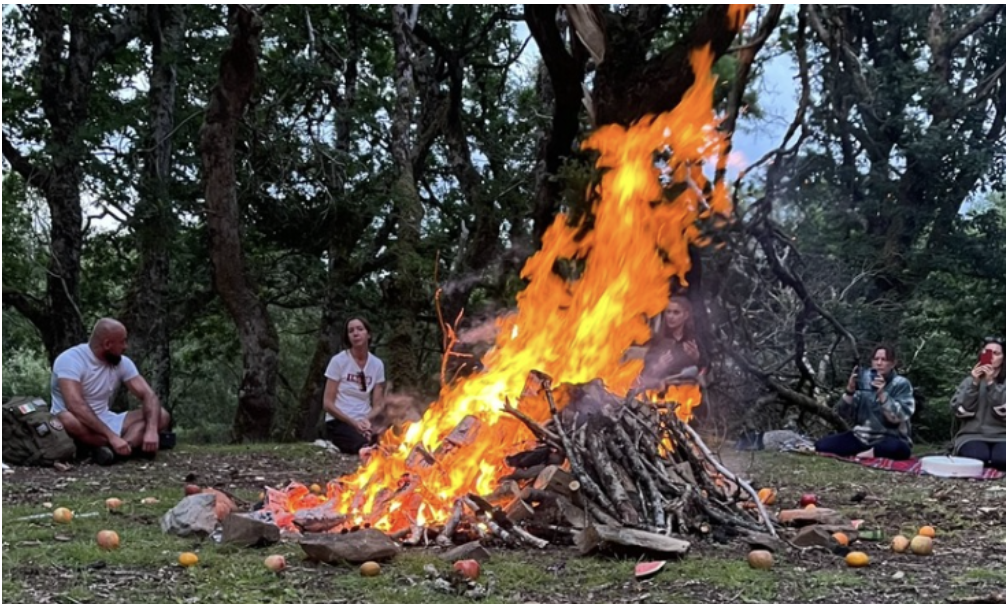
This is where many people feel the pulse of what they call celtic shamanism Ireland most strongly. Fire festivals, ancestral rites, vigil, invocation, prayer at sacred waters, offerings made with sincerity, walking the land in ceremonial awareness – these are not abstract concepts. They are embodied acts of relationship.
And yet, not every seeker will experience this in the same way. Some encounter profound healing through silence and listening. Others through guided ritual, storytelling, chanting or journeywork. Some feel an ancestral recognition so immediate it undoes them. Others meet resistance first. Ireland can be tender, but it is not sentimental.
Why people are drawn to this path now
Many who come seeking Ireland spiritually are not looking for novelty. They are looking for relief from numbness. They are tired of experiences that skim the surface. They want a spirituality with soil under its nails. They want to remember how to belong.
That longing is understandable. Modern life is loud, fractured and often uprooted from season, place and communal ritual. A land-based path offers another rhythm. It brings the body back into the circle. It restores the sacredness of threshold, grief, celebration, darkness, fertility, death and renewal.
For members of the Irish diaspora, the pull can be especially deep. Sometimes it arrives as curiosity. Sometimes as sorrow. Sometimes as a dream that will not leave them alone. But ancestry, too, must be approached with care. Not every spiritual feeling is a recovered memory. Not every ancestral pull grants immediate belonging. The relationship is built through reverence, patience and honest listening.
The question of authenticity
This is where many readers pause, rightly so. How do you know what is authentic?
Authenticity in this field is not proved by theatrics, titles or certainty. It is felt in rootedness. It shows in guides who know the stories of a place, who understand its cultural and spiritual layers, who do not flatten Ireland into a generic mystical backdrop. It appears in practices that honour boundaries, context and the intelligence of the land itself.
A trustworthy path will make room for mystery without manufacturing drama. It will acknowledge what is known, what is inherited, what is intuitive and what remains uncertain. It will not claim ownership over traditions that are communal, evolving and sacred.
This is also why guided pilgrimage can matter so much. When held well, it offers a container strong enough for spiritual depth and grounded enough to prevent drift into fantasy. At its best, guidance does not mediate your experience of the land. It helps you meet it more truthfully.
For those called to walk in this way, journeys such as those held by Ancient Spiritual Tours Ireland can open access not just to places, but to a right relationship with them – through ritual, seasonal alignment, story and the presence of trusted healers, shamans and druids who walk with reverence.
A path of relationship, not consumption
If the phrase celtic shamanism Ireland is to mean anything of worth, it must lead us away from spiritual consumption and towards devotion. That may mean letting go of the desire for instant certainty. It may mean accepting that the greatest encounter is not dramatic but quietly life-altering. It may mean discovering that the land does not give itself to those who rush.
Ireland is full of sacred places, yes. But more than that, it is a sacred conversation. One that asks for your attention, your humility, your willingness to be unmade and remade by weather, story, stone, prayer and season.
If you feel drawn to what Celtic shamanism in Ireland points toward, that pull is not accidental.
This is not a path of learning alone. It is a path of encounter.
This is why we guide small groups through Ireland’s sacred sites, working with land, story, and ritual in a way that allows people to experience this directly, not just understand it.
If you are ready for that kind of relationship with Ireland, this is exactly what our journeys are designed for.