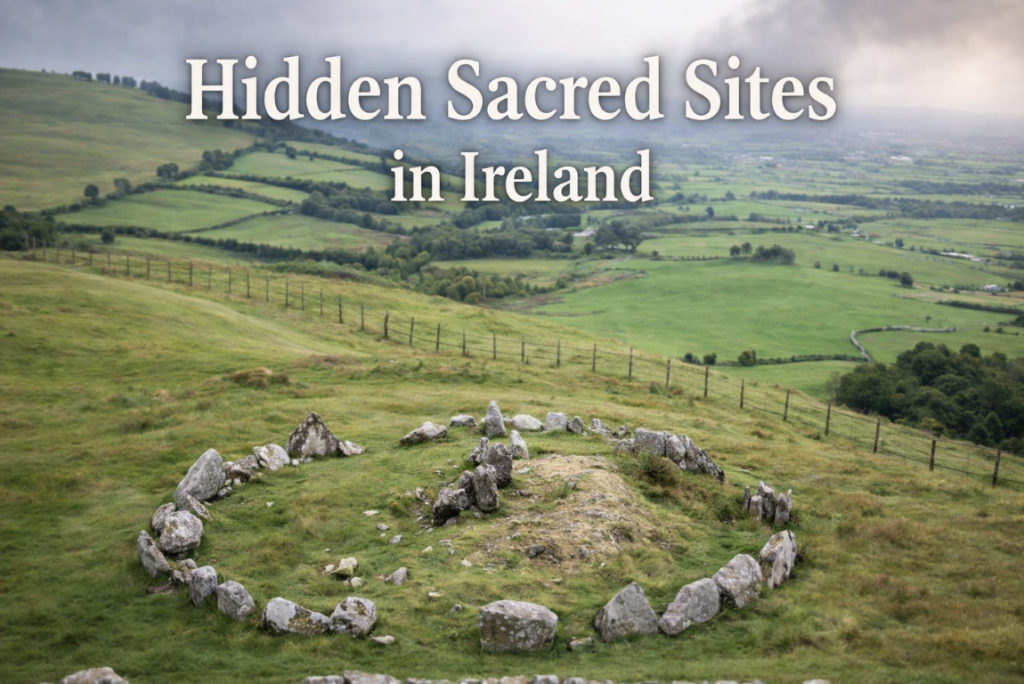
If you’re searching for hidden sacred sites in Ireland, you’re not looking for the places everyone already knows. You’re looking for something quieter. Something real. The kind of place that doesn’t announce itself, but changes you the moment you arrive.
For the traveller who feels called to Ireland by something older than a holiday brochure, this distinction matters. The country’s best-known sacred places carry real power, but the quieter sites often ask more of you. They ask you to arrive slowly. To listen rather than consume. To sense the continuity between pre-Christian reverence, folk practice, ancestral memory and the living land itself.
This is the Ireland most visitors never find, not because it is hidden, but because it is not approached in the right way.
Why hidden sacred sites in Ireland matter
Ireland is often spoken of through its monuments – Newgrange, the Hill of Tara, Glendalough, Croagh Patrick. They deserve their place in the story. But sacred Ireland was never contained by a handful of famous names. It has always been woven through springs, islands, caves, wells, boulders, ringforts and remote church ruins where local people continued acts of prayer long after official histories moved on.
The hidden sacred sites in Ireland matter because they reveal that sanctity here was never only institutional. It was local, intimate and often fiercely enduring. A well might be tended by generations of women. A tree might hold ribbons, prayers and grief. A hill might be known not for spectacle, but for the sense that the veil thins there at certain times of year.
There is a trade-off, of course. Lesser-known places can be harder to access, harder to interpret and easier to misunderstand. Without context, a visitor may see only stones and weather. Sacred depth is not always visually dramatic. Sometimes it is carried in story, seasonal custom, or the knowledge of those who still keep relationship with the place.
Not hidden because they are secret
When people search for hidden sacred sites Ireland offers, they often imagine secret locations concealed from the world. The truth is subtler than that. Many of these places are not hidden by design. They are hidden by modern habits of attention.
We have been taught to value what is mapped, promoted and made legible. Yet sacred landscapes do not always reveal themselves to a hurried eye. In Ireland, a place may look ordinary until you notice the rag tree nearby, the worn path around a well, the pattern of old pilgrimage rounds, or the fact that local people lower their voices as they approach.
This is why pilgrimage differs from sightseeing. Sightseeing asks, what is there to see? Pilgrimage asks, how should I enter? One seeks information. The other seeks right relationship.
The kinds of places that still carry old devotion
Holy wells are perhaps the clearest example. Across Ireland, thousands of wells have been honoured for healing, blessing and prayer. Some are dedicated to saints, but many stand on much older sacred ground. Their power lies not only in water, but in continuity. People have come with ailments, hopes, children, losses and vows. They have left offerings, walked rounds, spoken names aloud. Even now, many wells remain active, though you would pass them easily if you did not know what you were looking for.
Standing stones and stone circles can hold a different kind of charge. Not every stone is ceremonial, and not every circle should be romanticised. Yet some sites still generate a palpable stillness, as if they gather weather, memory and attention into one field. The mistake is to treat them as props for fantasy. Their real presence is quieter and often more demanding.
Island monastic sites also belong in this conversation. In places reached by boat or by a causeway at the mercy of tide and season, the physical act of getting there becomes part of the devotion. The threshold is not metaphorical. You cross water. You leave behind certainty. Such places carry Christian monastic history, certainly, but often rest within a much older matrix of sacred geography.
Then there are hills, caves and springs linked to seasonal festivals. Around Bealtaine, Lughnasa and Samhain, certain landscapes feel differently alive – not because of performance, but because old ritual calendars were shaped in deep relationship with land. To walk these places at the right time of year is to understand that sacredness in Ireland has always been seasonal as well as spatial.
How to approach hidden sacred sites with respect
The first discipline is humility. Not every place that moves you is asking to be photographed, named online or turned into content. Some sacred sites are fragile ecologies. Others are held in quiet trust by local communities. A reverent approach may mean leaving no offering except prayer, taking no image at all, and speaking of the place only in general terms.
The second is preparation. Sacred travel is richer when you arrive with some understanding of the cultural layers beneath your experience. Ireland’s spiritual landscape is not neatly divided into pagan and Christian, ancient and modern, mythic and practical. It is braided. A holy well may contain all of these strands at once. If you force it into a tidy category, you miss its true nature.
The third is pace. Hidden places rarely respond to rushing. Sit down. Let the first impression pass. Notice the wind, birdcall, water movement, the smell of earth after rain. Often the deepest moment comes ten minutes after you thought nothing was happening.
The difference between access and relationship
This is exactly why we guide small, pilgrimage-led journeys across Ireland. Not to show you more places, but to help you enter them properly. Because without context, many of these sites remain just stones and landscape. With the right approach, they become something else entirely. This is not about seeing more. It is about seeing differently.
It is possible to visit a sacred site and remain untouched. It is also possible to stand at the edge of a ruined enclosure and feel an ancestral sorrow rise in you without warning. The difference is not always belief. More often, it is relationship.
Relationship asks for reciprocity. What are you bringing besides curiosity? Attention, gratitude, restraint, prayer, perhaps grief that is ready to be met. Ireland’s hidden sacred places are not there to perform for us. They are places where memory is still alive in the land. If you come only to take, the encounter stays shallow.
This is where guided pilgrimage can matter. In the right hands, guidance does not crowd the mystery. It protects it. A skilled guide can help you enter with cultural respect, spiritual orientation and local understanding that turns a beautiful stop into a meaningful threshold. That is very different from a standard coach commentary or a rushed heritage visit. This is not a tour. It is a pilgrimage.
For those who feel called to go deeper, Ancient Spiritual Tours Ireland creates journeys shaped around ceremony, seasonality and sacred relationship, rather than a checklist of landmarks. That difference changes everything.
In Irish tradition, these landscapes were never empty. They were understood as places where the presence of the Sí, the memory of the Tuatha Dé Danann, and the lives of those who came before were still woven into the land. That understanding hasn’t disappeared. It has simply gone quiet.
What many travellers get wrong
One common mistake is assuming the most powerful places are the most dramatic. Ireland does have dramatic places, and many are deeply sacred. But some of the strongest encounters happen in small, easily missed sites where devotion has soaked into the ground through repetition rather than spectacle.
Another mistake is chasing an imagined Celtic past without allowing for complexity. Sacred Ireland is not a museum reconstruction of ancient spirituality. It is a living weave of folklore, Catholic practice, pre-Christian memory, folk healing, local custom and personal encounter. If you come looking only for one pure strand, you may overlook the beauty of the whole cloth.
The final mistake is treating sacred travel as escape. Real pilgrimage does not help you avoid yourself. It brings you into clearer contact with what is unresolved, unlived or half-remembered. A hidden well or solitary stone can become a mirror as much as a destination. That is why these places linger long after the flight home.
A quieter Ireland, still speaking
There is an Ireland beyond the postcard, beyond the polished route, beyond the hunger to tick off the famous names. It waits in the margins – in fields, by springs, on old paths, under thorn trees, in places where prayer has outlasted explanation.
If you feel drawn to these hidden sacred sites, trust that instinct.
Because this kind of pull is rarely about curiosity.
It’s recognition.
And the difference between reading about these places and walking them, with the right awareness, is everything.