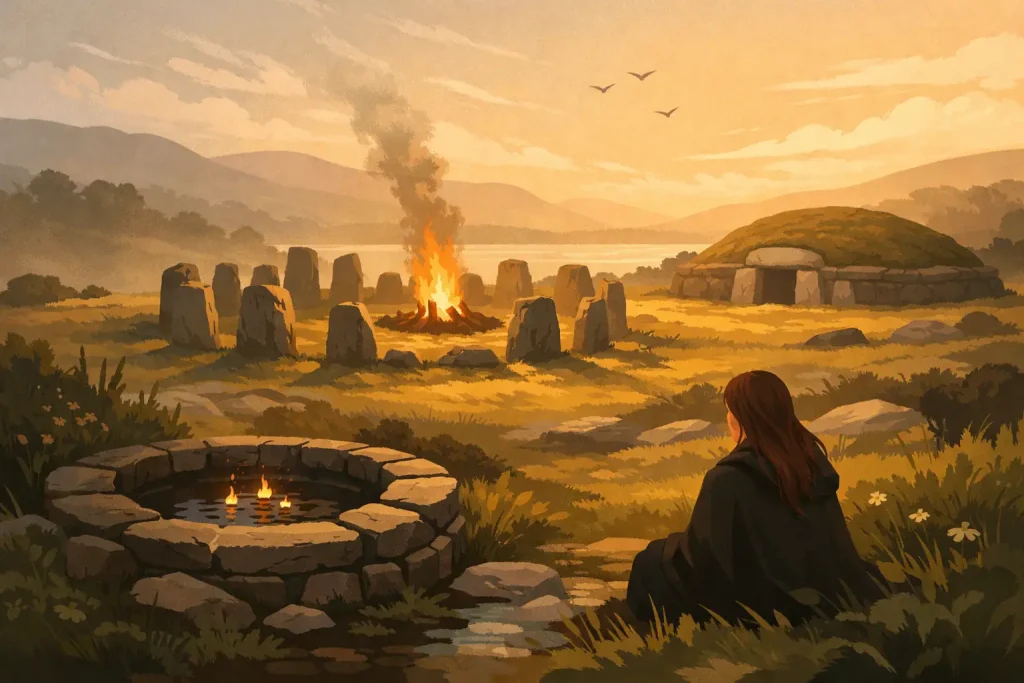
A fire on a hilltop changes the quality of the night. The air sharpens, the dark seems to listen, and something old begins to stir in the body before the mind can name it. That is often the first true answer to how to experience Celtic Bealtaine – not as a festival to observe from the edge, but as a threshold to cross.
Bealtaine is one of the great turning points of the Celtic year. It marks the beginning of summer, the quickening of life, and the meeting point between fertility, protection, passion and blessing. In the old Irish tradition, this was the season of sacred fires, of cattle driven between flames for purification, of community gathered at liminal places, and of a living relationship between people, land and the unseen world.
To meet Bealtaine properly, you need more than dates, symbols and a well-meaning ritual found online. You need context. You need place. Most of all, you need a way of approaching the land that is reverent enough to let it speak.
What Bealtaine really asks of you
Many people come to Bealtaine looking for celebration, and there is joy in it, certainly. Blossoming hedgerows, lengthening evenings, the scent of hawthorn in the lanes, birdsong rising before dawn – all of this belongs to the season. Yet Bealtaine is not only lightness. It is a crossing.
Traditionally, threshold times in the Celtic calendar are potent because they unsettle the ordinary boundaries. Bealtaine stands between spring and summer, between what has been gestating and what is now ready to emerge. It can feel creative, sensual and expansive, but it can also bring discomfort. Anything false or stagnant becomes harder to carry. Anything waiting to live more fully begins to press at the edges.
This is why the experience matters more than the information. Reading about Bealtaine may give you history. Standing on Irish soil at this time of year, held within ritual and story, can give you recognition. For many people, that is the deeper reason they come.
How to experience Celtic Bealtaine beyond performance
There is a difference between reenactment and encounter. One can be interesting. The other can change you.
If you want to experience Bealtaine in a way that feels true to its roots, begin by letting go of the need to manufacture something dramatic. The old festivals were woven into communal life, seasonal labour, local customs and a direct dependence on the land. Modern seekers often arrive carrying longing, but also habit – the habit of consuming experiences quickly, documenting them immediately, or trying to extract meaning on demand.
Bealtaine does not respond well to being hurried.
A more faithful approach is simple, though not always easy. Slow down enough to notice what the season is doing around you. Be somewhere with a real relationship to the old ways. Listen to the stories attached to the land. Enter ritual with care, not performance. Allow silence to be part of the experience, because some things arrive only when there is room for them.
It also helps to accept that not every Bealtaine experience looks the same. For one person, it may be a powerful fire ceremony and a deep release. For another, it may be the quiet shock of hearing an old myth at a sacred site and realising it has something to say about their own life. The outer shape varies. The inner movement is what matters.
Why Ireland is the right place to meet Bealtaine
Bealtaine can be honoured anywhere, but Ireland holds a particular resonance. This is a land where the old calendar still breathes through place names, folklore, farming memory and sacred geography. Certain hills, wells and ancient sites are not relics of a dead culture. They still carry charge.
To be in Ireland at Bealtaine is to feel the season held in a wider field of meaning. The land itself teaches. The brightness of gorse along the roadside, the softness of rain moving over stone, the sudden opening of a green field beneath an ancient hill – these are not backdrops. They are part of the ceremony.
And there is another layer. For many in the diaspora, and for many who have long felt called to Ireland without fully understanding why, Bealtaine can awaken a sense of return. Not always to ancestry in a literal sense, though sometimes that is part of it. More often, it is a return to rhythm, to devotion, to a way of being that recognises life as sacred rather than efficient.
Sacred sites and the Bealtaine current
In the old tradition, fire and hilltops are deeply linked with Bealtaine. Uisneach, often named as the sacred centre of Ireland, is especially associated with the festival. It is a place of sovereignty, assembly and elemental power, where the Bealtaine fire was said to be lit and seen across the land.
To visit a site like this casually is one thing. To arrive with preparation, guidance and ritual awareness is another entirely. Sacred places do not open in the same way to every pace of attention. If you rush in, take your photograph and move on, you may leave with a pleasant impression. If you are invited to listen, to stand still, to hear the mythology, to understand why this place mattered and still matters, the encounter deepens.
That depth is not about making grand claims. It is about relationship. Some sites feel fierce. Some feel tender. Some bring emotion to the surface with little warning. A good pilgrimage honours this rather than flattening it into a neat spiritual storyline.
Ritual, story and the need for guidance
People are often drawn to create their own Bealtaine experience, and there is beauty in personal ritual. But there are moments when being guided matters.
The old Irish sacred landscape is layered. Myth, history, folk practice and energetic experience sit close together, and without proper holding it is easy to reduce everything to symbolism or sentiment. Guidance brings shape. It helps you enter the season with respect rather than projection.
This is exactly why we guide small, pilgrimage-led journeys across Ireland.
Not to show you more places, but to help you meet them properly.
Through story, ritual, silence and presence, the land is not explained from the outside. It is encountered from within.
This is not a tour.
It is a different way of travelling entirely.
A well-held Bealtaine pilgrimage might include fire ceremony, prayer, ancestral reflection, time at ancient ceremonial sites, and space for your own inner process to unfold. It does not force revelation. It creates the conditions in which revelation becomes possible.
What to bring to a Bealtaine pilgrimage
Bring warmth, yes, because Irish evenings can turn quickly even in May. Bring practical shoes, because sacred ground is still ground. But inwardly, bring something else as well.
Bring willingness. Bring humility. Bring the part of you that is tired of surfaces.
It helps to arrive without demanding a particular outcome. Some people come seeking healing, others clarity, others a deeper relationship with Celtic spirituality. All of that is welcome. Yet the strongest experiences often come when you stop asking the land to confirm your ideas and instead allow it to work on you in its own way.
If you are in a life transition, Bealtaine can meet you powerfully. If you are grieving, beginning again, standing on uncertain ground, or feeling an unnamed call towards a truer life, this seasonal threshold has a way of illuminating what is ready to be tended. Not always gently, but often wisely.
How to know if this path is for you
Not everyone wants this kind of journey. Some prefer clear itineraries, familiar comforts and a comfortable distance from mystery. There is nothing wrong with that. But if you are reading this, perhaps something in you is asking for another way.
Perhaps you do not want Ireland interpreted as scenery. Perhaps you want to feel the old pulse of it in your own body. Perhaps you are less interested in collecting destinations than in entering a living relationship with place, season and soul.
That is the real heart of how to experience Celtic Bealtaine. Not as an event to attend, but as a sacred interval in which the land, the fire and your own life begin speaking to one another again.
A Bealtaine pilgrimage in Ireland offers that meeting point. A homecoming. A remembering.
And if that stirs something in you, trust it. Some calls are quiet because they are true.