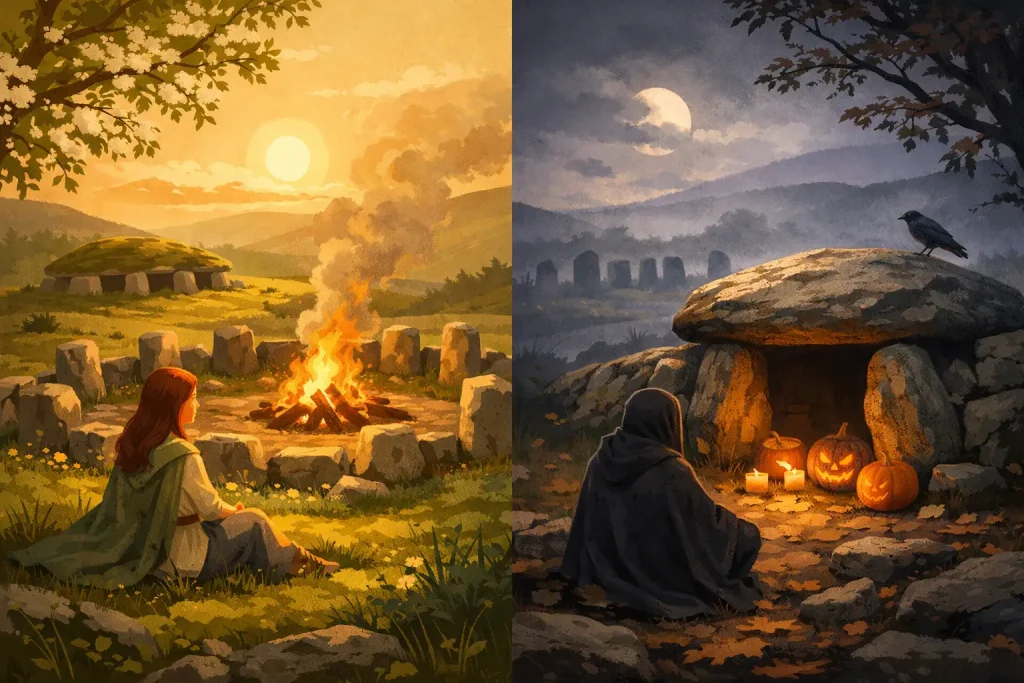
If you have ever felt the pull of Ireland most strongly at the edges of the year, you are already close to the heart of the bealtaine vs samhain question. These are not simply old festival dates on a Celtic calendar. They are living thresholds – times when the veil shifts, the land changes its voice, and what is hidden comes nearer.
To understand them properly, you have to step beyond the idea of seasonal celebration as something quaint or historical. In the old Irish tradition, Bealtaine and Samhain mark two great hinge points in the year. They do not mirror each other perfectly, but they do answer one another. One opens outward into fire, fertility, movement and becoming. The other draws inward into darkness, ancestry, descent and release.
That difference matters, especially if you are being called not just to learn about Ireland, but to meet it through ritual, place and presence.
Bealtaine vs Samhain: two sacred thresholds
In the simplest terms, Bealtaine arrives at the beginning of summer, while Samhain marks the beginning of winter. But those brief definitions barely touch the depth of what each carries.
Bealtaine is often associated with the rising life-force of the land. The days lengthen. The cattle were once driven towards summer pasture. Fires were lit for blessing, protection and renewal. It is a threshold of emergence, when what has been gestating begins to show itself. There is desire in it, but also risk. To come fully alive asks something of us.
Samhain moves in the other direction. Harvest is done. The outer cycle wanes. The old year dies back. This is the season most deeply linked with the ancestors, with the unseen world, and with the truths that become harder to avoid when the light recedes. Samhain is not merely sombre. It is honest. It asks what must be surrendered, mourned, honoured or completed.
If Bealtaine says, step forward, Samhain says, come closer to what is real.
What Bealtaine opens
Bealtaine has often been flattened into a cheerful spring festival, but in the old ways it carries more intensity than that. This is a fire festival, and fire does not only warm. It purifies. It marks crossing. It changes whatever passes through it.
In spiritual terms, Bealtaine can be a powerful time for those standing on the brink of a new chapter. A new relationship with self. A clearer calling. A return of vitality after grief, numbness or long inner winter. There is a reason so many people feel restless around this time without knowing why. The land itself is moving towards expression.
In Ireland, this season is felt not as abstraction but as atmosphere. Hawthorn begins to bloom. The air softens. Light lingers. Certain sacred places seem to wake differently. The old stories of sovereignty, union and blessing become easier to feel in the body, not just understand in the mind.
Yet Bealtaine is not all gentleness. It can stir what has been dormant. It can expose how disconnected modern life has left many people from rhythm, ritual and embodiment. For some, that feels exhilarating. For others, unsettling. Both responses are part of the threshold.
What Samhain asks of us
Where Bealtaine flames upward, Samhain descends.
This is the season that has survived most visibly in popular culture, though often in distorted form. Beneath costumes and noise, Samhain remains one of the most spiritually charged points in the Irish year. It is a liminal time, when the boundaries between worlds are believed to thin. The dead are remembered. The ancestors are invoked. The hidden becomes palpable.
But Samhain is not simply about spirits or folklore. It is about truth stripped of distraction. In the darkening half of the year, what has been avoided often comes into view. Grief. Lineage. fatigue. The shape of endings. The wisdom of letting go.
For many people, especially those moving through transition, Samhain feels strangely familiar. Not because it is easy, but because it does not demand performance. It allows for stillness, for listening, for the kind of ritual that does not decorate life but steadies it.
In Ireland, Samhain is felt deeply in the bones of place. The evenings close in. The wind carries memory. Ancient ceremonial sites connected with death, kingship and the otherworld seem to speak more clearly. Not theatrically. Simply with a kind of nearness.
Bealtaine vs Samhain in personal experience
The most meaningful way to approach bealtaine vs samhain is not to ask which festival is more important. It is to ask which threshold you are standing in.
Some people come to Bealtaine needing ignition. They have spent too long surviving, over-functioning, or living at a distance from their own aliveness. They do not need more information. They need a sacred setting in which to re-enter the current of life.
Others come to Samhain needing depth. Something is ending, or has already ended. They are not looking for uplift in the shallow sense. They are looking for ground. For ancestral contact. For a place where grief, mystery and belonging can be held without being tidied away.
And sometimes the answer is less straightforward. Bealtaine can bring up fear. Samhain can bring relief. A fire festival may call you into courage, while a dark festival may feel like home. This is where pilgrimage differs from performance. You do not attend these thresholds to act out an idea of Celtic spirituality. You come to meet what is actually moving in you.
Why place changes everything
You can read about both festivals for years and still remain outside them.
These traditions were never meant to live only on the page. They are land-rooted. Site-specific. Embedded in weather, stone, story and ritual action. The old calendar in Ireland is not merely a system of dates. It is a way of being in relationship with the turning world.
That is why celebrating Bealtaine in a meaningful way is different when you are standing on Irish soil, held by ceremony at a sacred site with others who have come for the same deeper reason. The same is true of Samhain. In the right place, with the right guidance, these festivals stop being concepts and become encounters.
This is exactly why we guide small, pilgrimage-led journeys across Ireland.
Not to show you more places, but to help you meet them properly.
Through story, ritual, silence and presence, the land is not explained from the outside. It is encountered from within.
This is not a tour.
It is a different way of travelling entirely.
Bealtaine and Samhain on pilgrimage
On pilgrimage, Bealtaine often carries a sense of blessing, movement and creative awakening. Rituals may centre around fire, intention, renewal and stepping into a fuller expression of life. The energy tends to be relational – with the land, with community, with what is trying to bloom.
Samhain pilgrimage holds a different quality. The work is often quieter, though no less powerful. It may involve ancestor ritual, remembrance, release and listening across the veil. Rather than asking, what wants to begin, it may ask, what is ready to be laid down, and who walks with you from beyond the visible?
Neither threshold is better. Neither is safer. Each asks for sincerity.
For some, Bealtaine is the right first doorway into Ireland’s sacred tradition because it carries warmth and outward momentum. For others, Samhain offers the deeper recognition – a homecoming through darkness, honesty and ancestral presence. It depends on where you are in your own cycle, and what kind of remembering has begun to stir.
Which one calls you?
A real answer rarely comes from preference alone. It comes from resonance.
If your life is asking for courage, embodiment, renewal or the blessing of a new beginning, Bealtaine may be the threshold waiting for you. If your life is asking for reflection, release, contact with the ancestors or a more intimate relationship with the unseen, Samhain may be closer.
Some people feel called to both, because the soul does not move in straight lines. We emerge, then release. We kindle, then descend. We meet the fire, then we meet the dark. Ireland holds both with extraordinary depth.
At Ancient Spiritual Tours Ireland, our sacred journeys are shaped around these living thresholds because they still matter. Not as reenactment. Not as spectacle. As real spiritual crossings, held in the right places, with reverence for what the land is still willing to reveal.
If something in you stirs at the thought of Bealtaine or Samhain, trust that response. It may be less about choosing a festival and more about recognising the season your own spirit is in. Explore our sacred journeys through Ireland, and let the land meet you where you are.
A homecoming often begins this way – not with certainty, but with a quiet knowing that one threshold, for now, is yours.