A crow lifts from the grass at Rathcroghan, and the mind reaches for an old name. The stories of the Morrígan have survived because they do not offer easy comfort. They speak of battle, prophecy, desire, grief and the fierce claim of the land itself. To meet her is not to meet a distant mythological figure. It is to stand before a presence that asks a more difficult question: how will you live in right relationship with the place that holds you?
For those drawn to Ireland through ancestry, spiritual practice or an unnameable pull, the Morrígan is often encountered at the threshold. Her stories do not promise that a journey will be gentle. They suggest, instead, that transformation asks for honesty, courage and the willingness to see what has been avoided.
Who is the Morrígan?
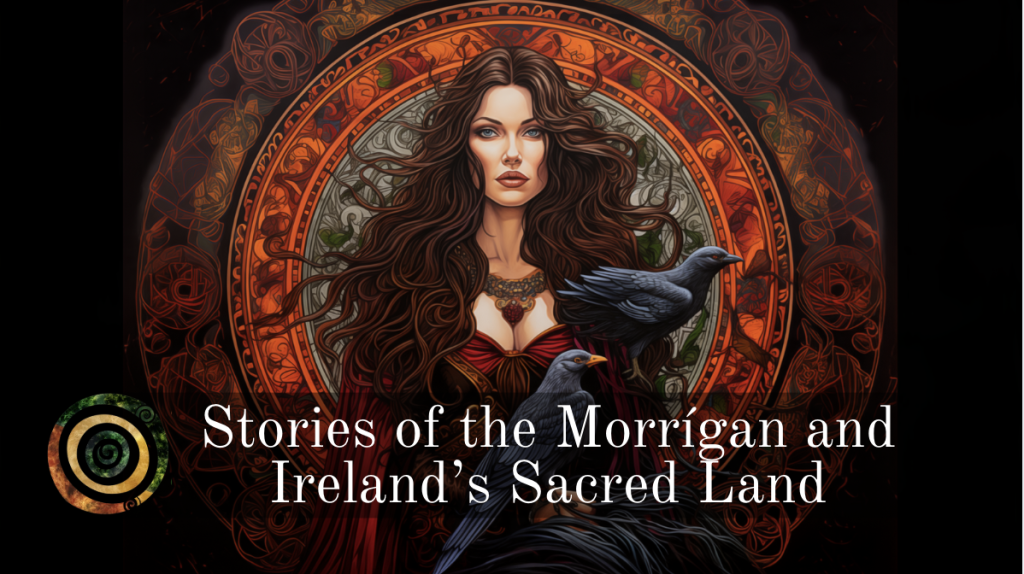
In early Irish literature, the Morrígan is a powerful and shifting figure, closely bound to sovereignty, conflict, the fate of kings and the wellbeing of the land. Her name is often translated as the Great Queen or Phantom Queen, though no single English rendering contains her fully. She appears as a woman, an old crone, an eel, a wolf and, most famously, a crow or raven moving above the field of conflict.
She is not simply a goddess of war. That description is too narrow, and it can make her seem like a figure of destruction alone. The Morrígan is concerned with the deeper consequences of power: whether leadership is rightful, whether promises are kept, whether a people remain in balance with the sovereignty of their land.
In some texts, she is named alongside Badb and Macha. At other moments, these names seem to describe separate beings, sisters or related aspects of a larger divine presence. Later retellings often present a neat triple goddess, but the surviving medieval material is less tidy. That uncertainty is not a flaw to be solved. It reminds us that these stories came from a living oral world, carried across generations before they were written down.
Stories of the Morrígan at the edge of battle
One of her best-known encounters is with the hero Cú Chulainn in the Táin Bó Cúailnge. Before battle, the Morrígan offers him her love and support. He rejects her, failing to recognise who stands before him. She then meets him in changing forms – as an eel, a wolf and a hornless red heifer – attempting to hinder him in the fight.
Later, wounded by Cú Chulainn, she appears as an old woman milking a cow. When he blesses her as he drinks, he unknowingly heals the injuries he has caused. The story has no simple moral. It holds conflict, pride, refusal, care and the cost of failing to recognise sacred power when it appears in an unexpected guise.
At the end of Cú Chulainn’s life, the Morrígan is associated with the washerwoman at the ford, washing the armour of those about to die. After he is killed, she is said to settle on his shoulder in the form of a crow. This image is often reduced to a dark omen. Yet it can also be read as witness. She is there at the boundary between the heroic story a person tells about themselves and the greater truth that finally remains.
These are not tales asking us to glorify violence. They were shaped in a world where cattle raids, kinship obligations and territorial power could decide whether a community endured. The Morrígan reveals what is at stake when force is used, when arrogance rules, and when relationship with land and community breaks down.
The meeting with the Dagda
Another compelling account appears in Cath Maige Tuired, the medieval tale of the battle between the Tuatha Dé Danann and the Fomorians. On Samhain, the Morrígan meets the Dagda beside the River Unshin, near the great ceremonial landscape of Rathcroghan in County Roscommon. Their union is strange, earthy and deliberately unpolished by modern standards.
Afterwards, she gives the Dagda counsel about the coming battle, telling him where and how they will overcome their enemies. Here she is neither ornament nor prize. She is strategist, prophet and a power rooted in the turning of the season. Samhain, when the old year thins into the dark half, is not merely a date in the calendar. It is a threshold. The Morrígan belongs to such places of crossing, where certainty loosens and a truer reckoning begins.
Rathcroghan and the living memory of place
Rathcroghan, Cruachan in Irish, is one of the landscapes most deeply associated with the Morrígan. This ancient royal complex in County Roscommon holds burial mounds, ritual earthworks and the cave known as Oweynagat, the Cave of the Cats. In medieval tradition, it is a place from which otherworldly beings emerge at Samhain.
It would be easy to approach such a place wanting proof: a clear sign, a dramatic sensation, a moment that confirms every story we have read. Sacred ground asks for a different posture. It asks us to listen before we interpret. It asks us to notice the weather, the silence, the body’s response and the histories that lie beneath our feet.
Not every visitor will experience Rathcroghan in the same way, nor should they. A pilgrimage is not a performance of spiritual intensity. Sometimes the most truthful encounter is quiet: standing at the mouth of a cave, feeling the pull of an old story, and recognising that the land does not need to reveal itself on demand.
The Morrígan’s connection to sovereignty matters here. In the Irish imagination, sovereignty was not an abstract political idea. It was bound to the fertility, health and integrity of the territory. A ruler’s right to lead depended on right relationship. When that relationship was violated, the consequences were felt in the whole community.
This offers a searching question for our own time. What would it mean to treat land not as scenery, possession or backdrop, but as a presence to which we owe attention? The answer will differ for each person. For some, it begins with ancestral inquiry. For others, it is grief for a place damaged or forgotten. For many, it is the simple practice of becoming still enough to hear what the rush of ordinary life has drowned out.
Meeting the Morrígan without trying to tame her
There is a temptation to make the Morrígan palatable: a symbol of empowerment with all difficulty removed, or a dark goddess made exotic and frightening from a safe distance. Neither approach does justice to her. The old tales are full of contradiction because life is full of contradiction. They do not ask us to choose light over shadow. They ask us to become more whole.
If you feel called to work with her stories, begin with respect rather than certainty. Read more than one translation. Learn the place names. Notice where modern spiritual interpretations depart from the early sources, and allow both scholarship and personal experience their proper place. A personal relationship with myth can be meaningful, but it should not overwrite the cultural and historical ground from which the story arose.
There is wisdom, too, in meeting these stories in Ireland rather than only through a page or screen. A hill, a cave, a riverbank or a stone-lined field can return scale to the imagination. Not because the land gives us a shortcut to ancient answers, but because it asks more of our presence.
This is exactly why we guide small, pilgrimage-led journeys across Ireland. Not to show you more places, but to help you meet them properly. Through story, ritual, silence and presence, the land is not explained from the outside. It is encountered from within.
At Ancient Spiritual Tours Ireland, sacred sites are approached with care, local knowledge and room for what cannot be planned. This is not a tour. It is a different way of travelling entirely.
The Morrígan does not ask for admiration from a distance. She asks for attention at the threshold: to the story beneath the story, to the place beneath the map, and to the part of yourself that knows a homecoming may require change.