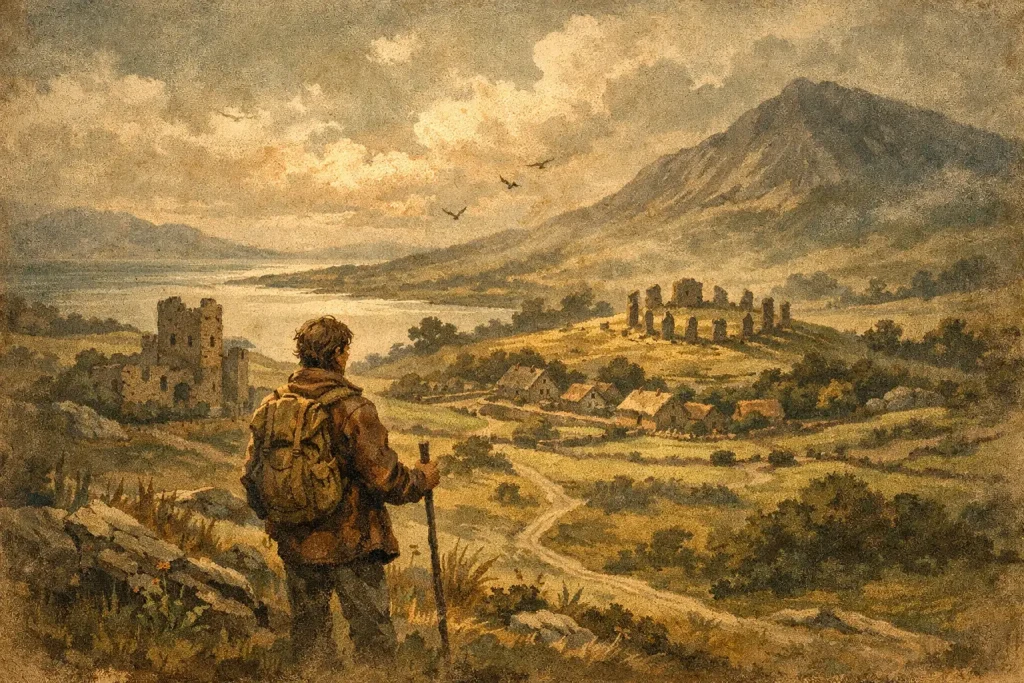
There are moments in life when Ireland stops being an idea and becomes a call. Not a call to tick off castles, drink stout, and post a few windswept photographs, but a quieter summons – one that rises through the bones. An ancestral pilgrimage Ireland experience begins there, in that strange recognition that the land may know something about you before you know it yourself.
For many in the diaspora, and for many who feel spiritually claimed by this island without a neat bloodline to explain it, the longing is not simply historical. It is bodily. It can arrive as grief, restlessness, recurring dreams, or a fierce tenderness for old songs, old stories, and the edges of the Atlantic. What brings people here is rarely tourism in the usual sense. It is remembrance. Sometimes healing. Sometimes a question that has waited years for the right ground beneath it.
What ancestral pilgrimage in Ireland really means
This is not genealogy with scenic stops. An ancestral pilgrimage in Ireland can include family research, parish records, and visits to ancestral counties, but if it is true pilgrimage, it asks more of you than recognition. It asks presence.
Pilgrimage changes the relationship between traveller and place. You do not arrive to consume the land. You arrive to enter into right relationship with it. That may mean standing at a holy well in silence rather than rushing to the next landmark. It may mean learning the old stories of a hill before setting foot on it. It may mean allowing a ruined abbey, a ring fort, or a shoreline to stir sorrow you did not expect.
Ancestral work is not always tidy. Some people come seeking pride and belonging, only to meet stories of famine, exile, religious conflict, or family severance. Others discover that their longing is wider than bloodline. They are not looking only for who their people were, but for a way of being human that modern life has thinned out – ritual, reciprocity, kinship with land, and a deeper sense of soul.
Why the land matters more than a family tree
Records can tell you where someone was born, baptised, married, or buried. They matter. They can be powerful doorways. But they cannot tell you what the wind was like in that valley, what prayers were whispered at that well, or what grief settled into a family after leaving.
The Irish landscape holds memory differently. Bogs preserve. Stones remember. Place names carry old cosmologies inside them. A mountain may be linked to a goddess. A lake may hold a saint’s blessing layered over an older pagan current. A crossroads may once have marked a threshold between worlds. To walk these places with reverence is to encounter ancestry not as data, but as living pattern.
This is why an ancestral pilgrimage Ireland journey often reaches beyond one surname or county. A person may come to find roots in Cork or Donegal and discover that the deeper encounter happens at Brú na Bóinne, on the Hill of Uisneach, at Loughcrew, or on a western shore where the Atlantic strips away every false certainty. Sacred sites can work on a person even when there is no documented family tie. The land does not speak only to lineage. It speaks to soul memory as well.
The difference between heritage travel and pilgrimage
Heritage travel tends to focus on information. Pilgrimage focuses on transformation. One is not better in every circumstance, but they are not the same.
If you want a broad overview of Irish history, museums, city landmarks, and a comfortable circuit of major attractions, a standard heritage trip may serve you well. If you feel called to enter sacred sites with guidance, ceremony, and time enough to listen inwardly, then a pilgrimage is the truer vessel.
That difference matters because sacred places are easily flattened by speed. Newgrange can become just an impressive monument. A holy well can become just a photogenic stop. Tara can become just a hill with a fine view. Yet each of these places carries layers of myth, ceremony, kingship, devotion, and human longing. Without context and reverence, you can pass through them and receive very little.
This is not about being solemn for the sake of it. It is about consent and relationship. To approach a sacred place as sacred is to acknowledge that it is not merely there for your entertainment. Something shifts when you do.
What you may encounter on an ancestral pilgrimage Ireland journey
No two pilgrimages unfold in quite the same way, but certain elements return again and again. Story is one. Ireland is a storied land, and myth here is not decorative. It is part of how place reveals itself. To hear of Brigid, the Tuatha Dé Danann, the sovereignty goddesses, the saints, the poets, and the old festival fires is to enter a different map of reality – one in which land, spirit, ancestry, and destiny are woven together.
Ritual is another. A pilgrimage may include blessing rites, prayers for the ancestors, offerings made with respect, seasonal ceremony, or quiet practices of listening and reflection. These are not performances. At their best, they create a container strong enough for grief, gratitude, and revelation.
There is often healing too, though not always in the way people expect. Healing may look like tears at a ruined church. It may come through laughter around a fire with fellow pilgrims. It may be the relief of no longer feeling spiritually strange because others understand why this matters to you. Sometimes the healing is simply this – your inner life is no longer treated as secondary to the itinerary.
The role of season and sacred timing
In Ireland, timing shapes meaning. A place visited at Samhain does not feel the same as that same place visited at Bealtaine. The Celtic Wheel of the Year still offers a profound rhythm for pilgrimage, because it aligns inner work with the turning of the land.
Autumn can draw forward ancestral grief, endings, and communion with those who came before. Spring and early summer may bring themes of renewal, fertility, courage, and emergence. Winter can sharpen prayer. High summer can illuminate sovereignty, vitality, and blessing.
This is one reason spiritually guided journeys can go far deeper than independent travel. When pilgrimage is shaped in harmony with the season, the sites, and the ceremonial thread, the experience becomes coherent in the old sense of the word – it holds together. What you visit outwardly meets what is moving within you.
It is not always easy – and that is part of its honesty
A genuine pilgrimage is not endlessly soft. Ireland can be tender, but she can also be fierce. Weather turns. Old grief rises. Fatigue has its say. Sacred places may unsettle you before they comfort you.
That is worth naming, because much of modern wellness culture promises only soothing. Pilgrimage is more truthful than that. It can console, yes, but it can also confront. You may find that your imagined ancestry is more complicated than your romantic version of it. You may have expected immediate belonging and instead meet silence first. You may have thought you were coming to find your people and realise you are also here to grieve what was lost.
Yet this is often where the real gift lives. Not in a polished spiritual experience, but in an honest one. A homecoming is rarely simple. It can be beautiful and demanding in the same breath.
How to choose the right guide for ancestral pilgrimage in Ireland
Because this work is intimate, guidance matters. The right guide does more than manage transport and timing. They know how to hold spiritual depth without theatrics, and history without flattening mystery. They understand that sacred sites are not content. They are thresholds.
Look for rooted local knowledge, clear reverence for place, and an approach that allows both structure and spaciousness. Be wary of anything that turns Celtic spirituality into costume, or ancestry into a sentimental fantasy detached from the realities of Irish history and living tradition.
At its best, a guided pilgrimage helps you travel in a way that is both protected and open. Protected, because the journey has been shaped with care. Open, because what happens within you cannot be scripted. This is where a company such as Ancient Spiritual Tours Ireland offers something uncommon – not a packaged holiday, but a held and meaningful passage through sacred land.
A pilgrimage asks who you are willing to become
People often begin by asking, where did my ancestors come from? It is a beautiful question. But pilgrimage tends to deepen it. By the end, another question is usually waiting: what am I being asked to remember, reclaim, or live differently now?
That is why the journey matters. Not because it gives you a perfect story about the past, but because it can restore relationship – with your lineage, with the land, with mystery, and with the part of yourself that has been waiting for a more ancient rhythm.
If Ireland is calling you in this way, trust that it may be asking for more than a visit. It may be asking for your attention, your humility, and your willingness to stand on old ground long enough to hear what is still speaking.