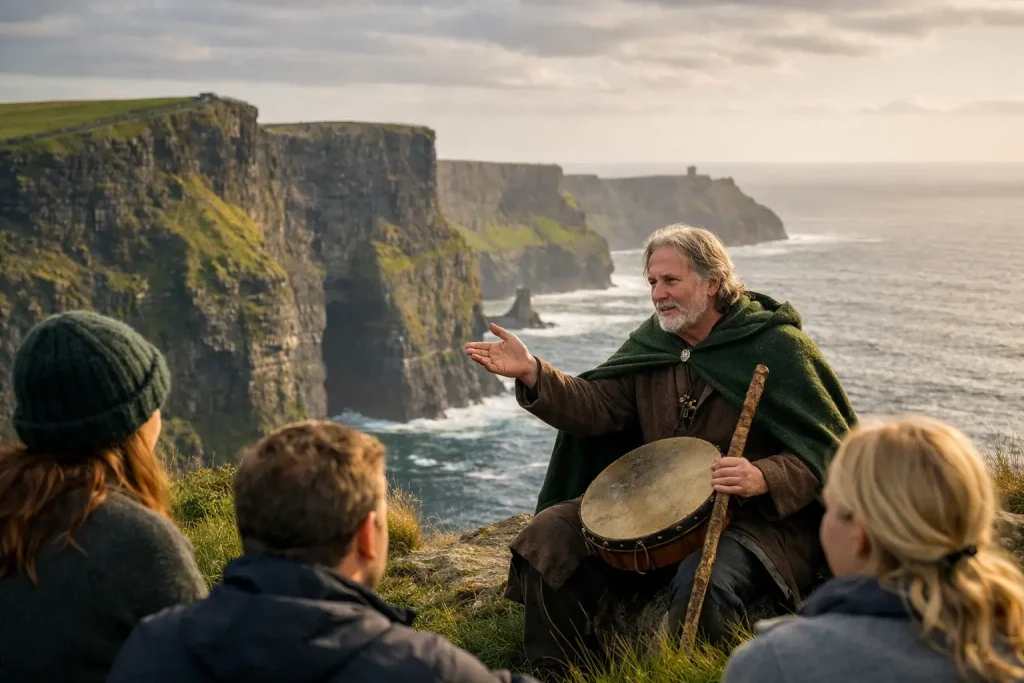
Stand on a windswept hill in County Meath at dusk and the old stories stop feeling like folklore. They begin to feel close, almost breathed through the grass itself. That is the true promise of an Irish mythology storytelling tour – not a bus ride with legends added for colour, but a felt encounter with the living memory of the land.
For many travellers, Ireland calls long before a flight is booked. The call arrives through ancestry, dreams, poetry, grief, or the quiet sense that something essential has been forgotten. Myth speaks directly to that longing because Irish myth was never only entertainment. It was a way of understanding place, fate, kinship, sovereignty, death, and renewal. When these stories are spoken where they belong, beside the cairn, the well, the ruined monastery, the sea cliff, they do more than inform. They awaken.
What makes an Irish mythology storytelling tour different
A conventional heritage tour often treats myth as an interesting layer placed on top of history. A sacred storytelling journey begins from another truth entirely – that story is part of the land itself. The old tales are not decorative extras. They are part of how Ireland has been known, remembered, and spiritually inhabited for centuries.
That difference matters. Hearing of Brigid in a generic lecture room is not the same as sensing her presence near a holy well, or tracing the continuity between goddess, saint, healing flame, and feminine guardianship in a place where devotion still lingers. Listening to the story of the Tuatha De Danann while standing in a myth-rich landscape changes the body’s relationship to the tale. You are no longer collecting facts. You are entering a field of meaning.
This is why the best mythology journeys are intimate, slow, and guided with reverence. They leave room for silence as well as words. They are not built around rushing from one attraction to the next. They honour the truth that some places ask to be approached, not consumed.
Irish mythology storytelling tour as pilgrimage, not performance
There is a difference between hearing a good story and being initiated by one. On a deeper Irish mythology storytelling tour, story becomes threshold. It can help a traveller understand why a certain landscape stirs tears, why a particular deity or archetype keeps appearing, or why a journey to Ireland feels less like tourism and more like return.
The old Irish cycles are full of these thresholds. The Mythological Cycle speaks of divine peoples, enchanted invasions, and the shaping of sacred terrain. The Ulster Cycle carries themes of valour, rage, destiny, and sacrifice. The Fenian Cycle wanders through loyalty, wildness, and the testing power of the natural world. The tales around Brigid, the Morrigan, Lugh, Danu, Oengus, and Cailleach continue to resonate because they are not fixed in the past. They still mirror inner states many seekers recognise.
A good guide understands this without flattening the myths into self-help slogans. Not every visitor needs a personal revelation at every standing stone. Sometimes the gift is subtler. A felt stillness. A memory stirred. A sense that the world is more enchanted than modern life allows us to admit.
Why place matters in Irish myth
In Ireland, myth is astonishingly local. A hill is not just a hill. A river may carry the memory of a goddess. A cave may be an entrance to the otherworld. A mound may be linked with kingship, burial, or the sidhe. Story and geography are woven so tightly together that to separate them is to lose much of their force.
This is why sacred sites such as Tara, Uisneach, Loughcrew, Knocknarea, the Burren, and countless lesser-known wells and ancient enclosures hold such power for mythology travellers. These are not merely scenic backdrops for storytelling. They are active presences in the tale. They shape what can be understood.
Of course, access and interpretation require care. Some sites are heavily visited. Others are vulnerable, quiet, and not suited to large groups. A tour that truly honours mythology must also honour the limits of place. It should recognise that sacred landscapes are not stages. They are relationships.
The role of the storyteller on a sacred journey
Not every guide can carry myth well. Knowledge matters, but presence matters just as much. The right storyteller does not perform Ireland as a costume. They listen deeply to the land, speak with humility, and understand the difference between reciting information and opening a doorway.
That may mean weaving together mythology, local lore, seasonal wisdom, archaeology, folk custom, and spiritual symbolism without pretending that all these strands are identical. Ireland’s sacred heritage is layered. Pre-Christian cosmology, Christian devotion, folk healing, bardic memory, and contemporary spiritual practice often sit side by side. The work is to honour complexity, not tidy it away.
For spiritually attuned travellers, this is often what makes the journey trustworthy. You are not being handed a commercial fantasy of “Celtic magic”. You are being invited into a more honest encounter with a living tradition – beautiful, fractured, resilient, and still speaking.
What you may experience on an Irish mythology storytelling tour
The outer form of the journey may look simple. A small group walks an ancient path. A local guide shares a tale at a hilltop cairn. There may be ritual at sunrise, a blessing at a holy well, or quiet reflection after visiting a site linked to an old goddess or hero. Yet what unfolds inwardly can be profound.
Many travellers find that mythology gives shape to experiences they could not previously name. Grief may meet the wisdom of the Cailleach. Creativity may be stirred by Brigid. Questions of power, boundaries, and transformation may echo through the stories of the Morrigan. A longing for right relationship with land may be sharpened through tales of sovereignty and sacred kingship.
It depends, of course, on the traveller and the intention they bring. Some come seeking ancestral connection. Others come because they are spiritually burnt out and need the medicine of older rhythms. Some simply know they are tired of polished itineraries that leave the soul untouched. Myth does not offer the same gift to everyone, and that is part of its integrity.
Choosing a tour with depth rather than surface charm
If you are considering an experience of this kind, listen for the deeper orientation behind the language. Many tours use words such as mythic, mystical, or Celtic, but not all are rooted in real relationship with Ireland’s sacred landscapes. Some are excellent for general visitors. Others are designed for those who want to go further.
A more meaningful journey will usually be smaller in scale and slower in pace. It will respect the spiritual atmosphere of place rather than treating every site as content. It may include ritual, seasonal awareness, ancestral reflection, or time for integration. Most of all, it will hold myth as something alive.
This is part of why companies such as Ancient Spiritual Tours Ireland speak of pilgrimage rather than holiday. The distinction is not marketing language. It points to a different way of travelling – one shaped by reverence, embodiment, and participation.
The stories are still happening
One of the deepest misunderstandings about Irish mythology is that it belongs to a vanished world. In truth, the stories continue to work upon those willing to meet them. Not because the past can be perfectly recovered, and not because every old tale carries one clear spiritual lesson, but because myth remains one of the oldest ways humans remember who they are in relationship to land, mystery, and one another.
Ireland still holds that remembering with unusual strength. In certain places, the veil feels thin not as a fantasy, but as an atmosphere of attention. You notice the weather differently. Stones feel less inert. Water seems to carry blessing and warning at once. A story heard in the right place can follow you home and keep unfolding for years.
If you feel called towards an Irish mythology storytelling tour, trust the quality of that longing. You may not be seeking entertainment at all. You may be seeking language for something ancient within you – something that recognises Ireland not as a backdrop, but as a teacher. And sometimes the first true step of pilgrimage is simply allowing yourself to be addressed by the story before you try to explain it.