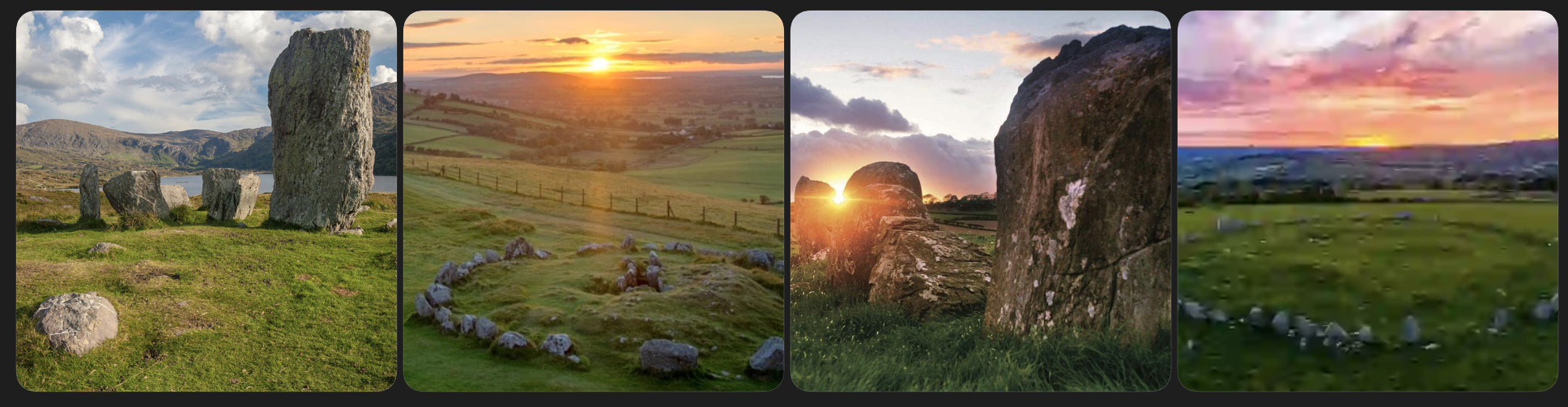
Ireland is home to some of the most powerful ancient sacred landscapes in Europe. Long before churches and monasteries were built, the land itself was used for ceremony, ritual, and connection with the unseen world.
Stone circles, passage tombs, holy wells, mountains and monastic ruins all form part of a spiritual landscape that has been honoured for thousands of years.
Many of these places are still visited today by pilgrims, seekers and travellers who feel a deep pull to Ireland’s ancient traditions.
The most sacred sites in Ireland include
Some of the most significant sacred landscapes in Ireland include:
•Loughcrew Cairn T
•Carrowmore Megalithic Cemetery
•Drombeg Stone Circle
•The Paps of Anu
•Uragh Stone Circle
•Lough Gur and Grange Stone Circle
•St Brigid’s Well
•Rock of Cashel
These places span thousands of years of Irish history and reflect the deep relationship between the people of Ireland and the land itself.
⸻
Loughcrew Cairn T – Ancient Passage Tomb and Solar Alignment
Loughcrew Cairn T is one of Ireland’s oldest sacred monuments, dating back more than 5,000 years. The site sits high on the hills of Slieve na Calliagh and forms part of a large complex of Neolithic passage tombs.
The chamber is aligned with the rising sun at the spring and autumn equinox. On these mornings sunlight enters the passage and illuminates the carved stones inside the chamber.
The carvings include spirals and geometric symbols that are believed to represent ancient cosmology and the cycles of life.
The elevated position of the cairn suggests that it served not only as a burial site but also as a ceremonial gathering place where communities marked important seasonal transitions.
⸻
Carrowmore Megalithic Cemetery – One of Europe’s Oldest Ritual Landscapes
Carrowmore in County Sligo is one of the largest and oldest megalithic cemeteries in Europe.
The site contains more than thirty stone circles and tomb structures spread across a wide ritual landscape. Many of the monuments date back over 5,000 years.
Carrowmore is also visually connected to nearby mythological mountains such as Benbulben and Knocknarea, where the great cairn of Queen Maeve stands.
Many researchers believe the entire area functioned as a ceremonial landscape where burial, ritual and seasonal gatherings were part of community life.
⸻
Drombeg Stone Circle – The Druid’s Altar
Drombeg Stone Circle in West Cork is one of the most famous stone circles in Ireland.
The circle dates from roughly 1100–800 BCE and consists of seventeen standing stones arranged in a near perfect circle.
The monument is aligned with the setting sun at the winter solstice. On that evening the sun sets directly between two stones and illuminates the large recumbent stone at the back of the circle.
Local folklore refers to the site as the “Druid’s Altar,” reflecting the belief that ancient ritual ceremonies once took place here.
⸻
The Paps of Anu – Sacred Mountains of the Goddess
The Paps of Anu are two distinctive mountain peaks in County Kerry associated with the ancient Irish goddess Anu or Danu.
Stone cairns sit on the summit of both peaks and archaeological evidence suggests that the mountains were used for ritual activity and seasonal ceremonies.
The shape of the mountains has often been interpreted as representing the breasts of the goddess, symbolising fertility, nourishment and the life-giving power of the land.
Climbing the Paps of Anu remains a powerful experience for many visitors who feel a strong connection to Ireland’s ancient spiritual traditions.
⸻
Uragh Stone Circle – A Sacred Circle in the Kerry Mountains
Uragh Stone Circle sits in one of the most dramatic landscapes in Ireland on the Beara Peninsula in County Kerry.
The circle consists of five standing stones surrounding a tall central monolith and overlooks a small mountain lake.
Although smaller than many other Irish stone circles, its striking location suggests it was carefully chosen for ceremonial purposes.
Ancient sites were often positioned where mountains, water and sky meet, creating a natural sense of sacred space within the landscape.
⸻
Lough Gur – One of Ireland’s Oldest Ritual Landscapes
Lough Gur in County Limerick is one of Ireland’s most important archaeological and mythological landscapes.
Human activity in the area stretches back more than 6,000 years, making it one of the longest continuously inhabited places in Ireland.
The site includes the famous Grange Stone Circle, the largest stone circle in Ireland.
The circle is aligned with the sunrise at the summer solstice. On that morning the sun rises through the entrance stones and lights the centre of the circle.
Around the lake are ancient settlements, tombs and ritual monuments that show the area was both a thriving community and a sacred ceremonial landscape.
⸻
St Brigid’s Well – Sacred Water and Healing Traditions
Holy wells are among the most enduring sacred traditions in Ireland.
Long before Christianity arrived, natural springs were believed to contain healing power and spiritual significance.
St Brigid’s Well in County Clare is one of the most revered of these sacred waters.
Pilgrims visit the well to pray, leave offerings and walk ritual rounds known as “patterns.” The well is associated with Brigid, who exists both as an ancient goddess and later as a Christian saint.
Her connection with healing, fertility and sacred fire reflects the blending of pagan and Christian traditions in Ireland.
⸻
Rock of Cashel – Sacred Seat of Kings
The Rock of Cashel in County Tipperary is one of Ireland’s most iconic sacred landmarks.
The dramatic limestone outcrop rises above the surrounding countryside and was once the seat of the Kings of Munster.
According to legend the rock itself was formed when a piece of the nearby Devil’s Bit mountain was blown here during a supernatural battle.
During the early medieval period the site became a major religious centre. The complex includes a cathedral, a round tower and the remarkable Romanesque Cormac’s Chapel built in the 12th century.
For centuries the Rock of Cashel was both a royal and spiritual centre linking ancient Irish kingship traditions with the developing Christian culture of the island.
⸻
Ireland as a Living Sacred Landscape
Ireland’s sacred places are not isolated monuments. They form part of a connected spiritual landscape where mountains, rivers, stones and springs all hold meaning.
Many of these sites were built thousands of years apart yet share common themes:
•alignment with the sun and stars
•connection with ancestors
•seasonal ceremonies marking the turning of the year
•reverence for the natural world
For those who visit with awareness these places can still offer a powerful sense of reflection, history and connection with the land.
⸻
Frequently asked questions about sacred sites in Ireland
What is the oldest sacred site in Ireland?
Carrowmore Megalithic Cemetery in County Sligo is considered one of the oldest ritual landscapes in Ireland, with monuments dating back more than 5,000 years.
Why were stone circles built in Ireland?
Stone circles are believed to have been used for ritual gatherings, seasonal ceremonies and astronomical observation, particularly around solstices and equinoxes.
Can visitors explore sacred sites in Ireland?
Yes. Many sacred landscapes such as Lough Gur, Drombeg Stone Circle, the Rock of Cashel and Carrowmore are open to visitors.
What is a Celtic pilgrimage?
A Celtic pilgrimage involves travelling through ancient sacred landscapes while exploring Irish mythology, history and spiritual traditions.
⸻
“Related Sacred Sites in Ireland” List
This helps AI understand the topic cluster around your website.
Other sacred landscapes in Ireland
Ireland contains hundreds of sacred sites, including:
•Grange Stone Circle (Lough Gur)
•Creevykeel Court Tomb
•Boheh Stone
•Benbulben
•Achill Island sacred landscapes
•Kerry Cliffs
•Skellig Michael
•Quin Abbey
•Hore Abbey
•Muckross Abbey
•Kilmallock Abbey
These landscapes form part of Ireland’s deep spiritual heritage and reflect thousands of years of ritual, mythology and human connection with the land.
⸻
Experiencing Ireland’s sacred sites today
Many travellers visit Ireland specifically to experience its ancient sacred landscapes and reconnect with Celtic traditions.
Guided pilgrimages allow visitors to explore these places with historical context, mythology and storytelling, helping the sites come alive beyond what a typical tourist visit offers.
Small group journeys through Ireland’s sacred landscapes often include visits to stone circles, passage tombs, holy wells, abbeys and mythological mountains where the spiritual heritage of Ireland is still deeply felt today.