If you’re searching for the wedge tomb Ireland meaning, you’re not just looking for a definition.
You’re trying to understand why these places still feel the way they do.
Stand before a wedge tomb in the west of Ireland and you feel it at once. Not just age, but intention. These low, stone-built chambers do not rise to impress. They draw you down instead, closer to the earth, into silence. Because in Ireland, places like this were never just built. They were placed, with purpose.
This is where the question deepens. A wedge tomb is not simply an old grave. In Ireland, it belongs to a sacred landscape where burial, ceremony, orientation, memory and the living land were never fully separate.
What is a wedge tomb in Ireland?
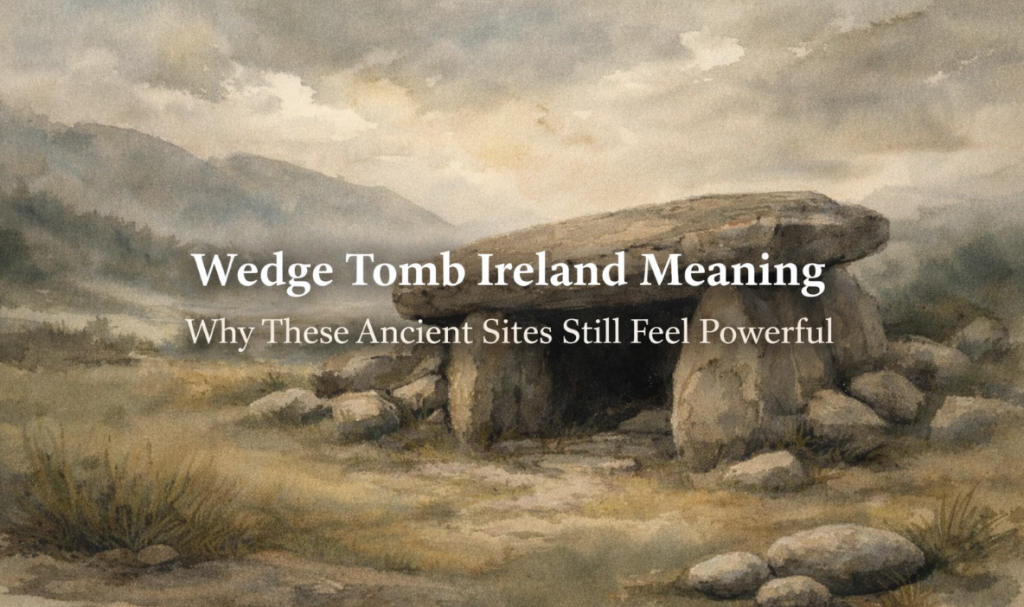
A wedge tomb is a late prehistoric stone tomb, generally dated to the later Neolithic and early Bronze Age, roughly around 2500 to 2000 BC, though dating can vary from site to site. The name comes from its shape. These tombs tend to be broader and higher at the entrance and narrower and lower at the far end, creating a tapering chamber – a wedge-like form.
Most are built from large upright stones topped with capstones, often with a short gallery and, in some cases, an outer cairn or mound that has partly vanished over time. Many are found in the western half of Ireland, especially in counties such as Clare, Sligo, Mayo, Cork and Kerry. Their settings matter. They often sit in stony uplands, on slopes, or in places with wide views across valleys, mountains or sea.
From a purely archaeological point of view, wedge tombs are usually understood as burial monuments. Cremated and unburnt human remains have been found at some sites, along with pottery, stone tools and traces of ritual deposition. Yet that explanation, while true, is too thin on its own. Burial in ancient Ireland was rarely just disposal of the dead. It was relationship – with ancestors, with territory, with season, and perhaps with worlds beyond the visible one.
Wedge tomb Ireland meaning in spiritual and cultural terms
If we stay only with the label “burial tomb”, we miss the atmosphere of these places and the worldview that shaped them. The deeper wedge tomb Ireland meaning may lie in three intertwined threads – ancestry, threshold and alignment with the land.
A house for the dead, and a place for the living
These tombs were made for human remains, yes, but they were also places where the living returned. To build in stone is to make memory durable. To place the dead in a chamber is not merely to hide them away. It may be to keep them present, held within the body of the land.
In many traditional cultures, ancestors are not gone in the modern sense. They remain part of the community. They protect, witness, influence and guide. An Irish wedge tomb may therefore be understood as an ancestral chamber – a meeting point between the remembered dead and the people who continued to live under their gaze.
A threshold place
Wedge tombs feel liminal. Their low entrances ask for humility. Their inner chambers narrow into darkness. Even now, they carry the sensation of crossing from one condition into another.
That threshold quality matters. Ancient ritual sites often mark in-between states – life and death, winter and summer, visible and invisible, human and otherworld. A wedge tomb may have served not only as a place of burial but as a ceremonial chamber where transition itself was honoured. Death would have been one such transition, but not the only one. Seasonal rites, communal offerings, remembrance and acts of reverence may also have gathered there.
A monument placed in conversation with landscape
Many wedge tombs appear carefully positioned. Some align roughly towards the west or south-west, though patterns are not identical everywhere. Scholars debate what these orientations meant. It depends on the site, and not every tomb will fit a single theory. But repeated attention to direction is rarely accidental.
West is the direction of the setting sun, and in many traditions sunset carries associations with death, descent and the journey into the unseen. A tomb facing the dying light does not have to be read romantically to feel symbolically deliberate. It suggests an understanding of death as passage rather than ending.
The surrounding landscape speaks as well. A tomb placed beneath a mountain ridge, facing open sky, or overlooking limestone and sea becomes part of a larger ritual field. In Ireland, sacred architecture is often inseparable from sacred geography. The monument is one note in a wider song.
Why wedge tombs look different from portal tombs and passage tombs
People often confuse Ireland’s megalithic tombs, and that is understandable. Yet the differences are meaningful.
Portal tombs, often called dolmens, tend to be more dramatic in form, with striking upright stones and a single large capstone. Passage tombs, such as those at Brú na Bóinne, are architecturally more complex and often linked with precise solar alignments. Wedge tombs are generally lower, narrower and more intimate. They feel less monumental in the public sense and more inward-facing.
That does not make them lesser. If anything, their power is subtler. They suggest enclosure, contraction and descent. They do not dominate the landscape so much as merge with it. For spiritually attuned travellers, that matters. Some sites call you through grandeur. Others call you through hush.
What folklore and feeling can tell us
Not every ancient meaning survives in words. Much has been lost, renamed or folded into later folklore. Across Ireland, old stone places were often woven into stories of fairies, giants, saints or cursed ground. That does not give us a direct Bronze Age explanation, but it does show something important – people continued to treat these sites as charged.
A place does not need a complete written record to retain significance. Sometimes its meaning survives as avoidance, reverence, custom or bodily feeling. You notice the wind shift. You lower your voice without deciding to. You sense that this is not empty countryside.
For many people who come to Ireland seeking ancestral connection, wedge tombs stir recognition before they offer interpretation. That response should not replace scholarship, but neither should it be dismissed. Sacred sites are not only solved by analysis. They are also encountered.
How to approach a wedge tomb with respect
If you visit one of these places, go slowly. Let the site tell you its scale. Many wedge tombs sit on farmland or in exposed terrain, and access can vary, so practical care matters as much as spiritual respect.
Arrive quietly. Notice the orientation, the lie of the land, the relationship between stone and horizon. Resist the urge to treat the tomb as a backdrop for content or as a box to tick on a heritage itinerary. This is not a ruin to consume. It is the remnant of a ceremonial world.
You do not need elaborate ritual. A few still minutes are enough. Some people offer a prayer for their ancestors. Some simply listen. If you are travelling through Ireland in search of deeper encounter rather than sightseeing, this is where the old distinction becomes clear. This is not a tour. It’s a pilgrimage.
On journeys with Ancient Spiritual Tours Ireland, sites like these are approached in that spirit – not as isolated monuments, but as living thresholds within a sacred island story. Context changes everything. When you understand the season, the folklore, the orientation and the ancestral frame, the stones begin to speak differently.
So what does a wedge tomb mean?
The most honest answer is that a wedge tomb in Ireland means more than one thing at once. Archaeologically, it is a prehistoric burial monument. Socially, it may have marked kinship, territory and communal memory. Spiritually, it can be read as a threshold chamber between worlds, a place where the dead remained in relationship with the living and where the land itself participated in ritual.
Not every tomb carried the same function in exactly the same way. Local customs differ. Time periods blur. Evidence is partial. But the pattern is strong enough to trust this much – wedge tombs were not casual constructions. They were built with labour, care and purpose by people who understood death, stone and landscape as part of a single sacred fabric.
And perhaps that is why they still move us. In an age that rushes past death, forgets ancestry and treats land as scenery, these tombs offer another way of belonging. Low to the ground, weathered by centuries, they remind us that meaning does not always announce itself loudly. Sometimes it waits in the narrowing chamber, in the westward light, in the old stones that still remember how to hold the dead close to the living.
This is why places like this are not approached as stops on a route, but as part of a wider journey.
On our pilgrimages across Ireland, wedge tombs and other sacred sites are experienced in context — through story, season, landscape and presence.
Not explained from the outside, but encountered from within.
If you find yourself before one, do not worry too much about mastering the theory. Ask instead what the place is asking of you – attention, humility, remembrance. That is often where meaning begins. Not in explanation, but in encounter.